Myth & Evidence
How much water per day? Why you can trust your thirst
Two litres, eight glasses, drink before you're thirsty? Where these rules come from, how your body manages its water, and when thirst comes too late.
"When you're thirsty, it's already too late." You've probably heard that one before. I think it's half right. The wrong half, though, creates a guilty conscience that nobody needs.
Maybe you also have a water bottle sitting on your desk that's still half full by evening. Two litres was the target, says one rule. Eight glasses, says another, and coffee doesn't count anyway. Somewhere along the way you also read that too much water can be harmful. So who are you actually supposed to believe? I looked into these numbers. There's no study behind the eight glasses, but what is well established is that our bodies regulate their own water balance, and they do it with remarkable precision. In everyday life, you can trust your thirst and stop counting glasses. Drinking ahead of thirst is only necessary in a handful of situations you can count on one hand.
AT A GLANCE: A healthy adult doesn't need to measure out a fixed amount of water in daily life. The body continuously monitors how concentrated the blood is and responds with a hormone that tells the kidneys to conserve water, and with thirst. Drinking with meals and whenever you feel thirsty is enough. Coffee and the water in food count too. You drink ahead of thirst when sweating heavily, during fever or diarrhoea, and in older age. For the "eight glasses a day" rule, physiologist Heinz Valtin found not a single scientific study in 2002 (Valtin, 2002). As of: November 2026.
Where Do the Eight Glasses and the Two Litres Come From?
The eight-glasses rule originated in the United States. There, eight glasses of eight ounces each were meant, which adds up to roughly 1.9 litres. That already brings us close to the two litres that have been making the rounds here. But what study does this rule actually rest on? That is exactly what Heinz Valtin wanted to find out in 2002, a physiologist at Dartmouth Medical School in the US state of New Hampshire. He searched the scientific literature and consulted nutrition researchers who had specialised in thirst and fluid intake, yet he found no study behind the eight glasses (Valtin, 2002). What he did find were numerous experiments showing how precisely our body regulates its own water balance.
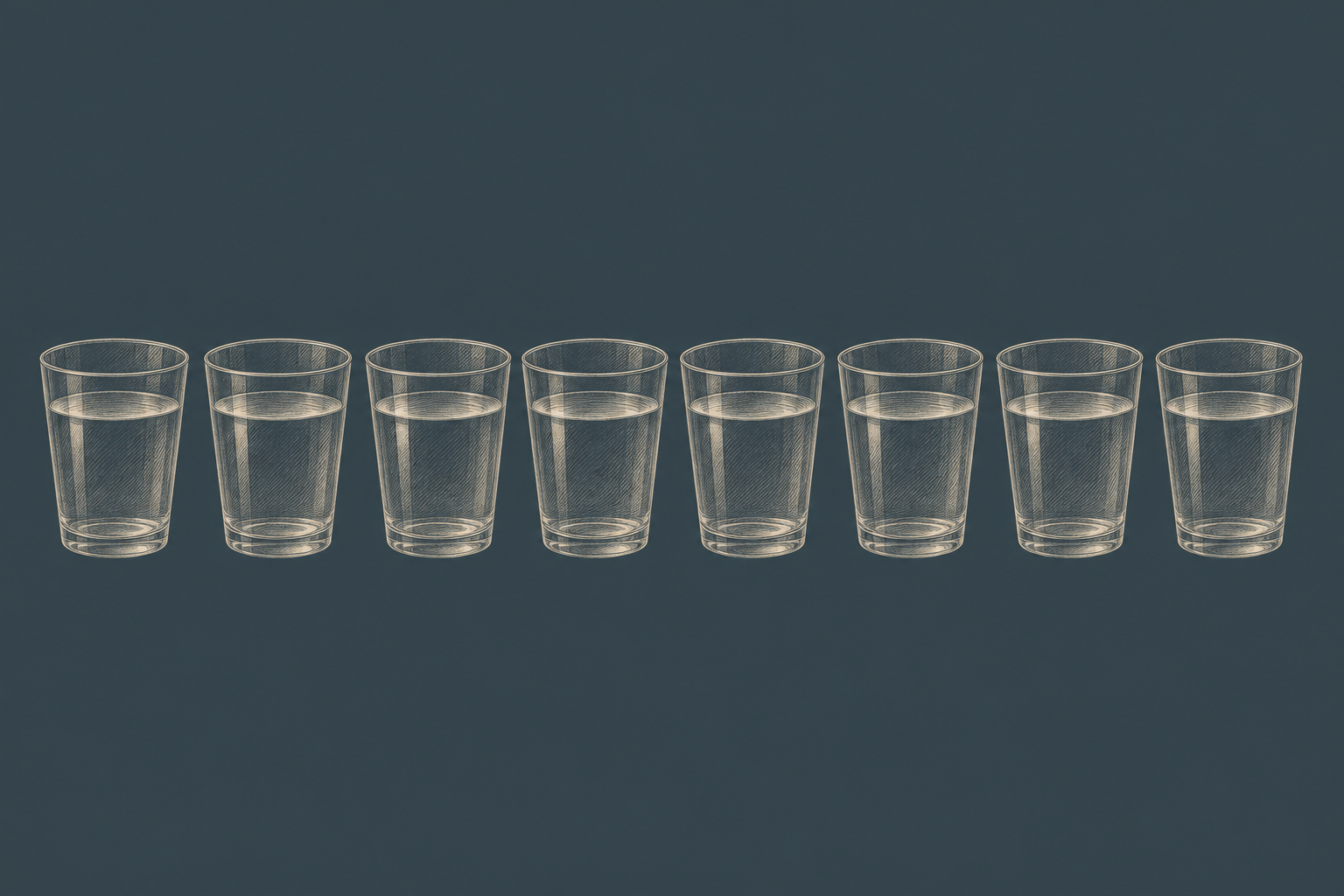
Eight glasses of eight ounces each add up to roughly 1.9 litres. So far, no one has found a study that actually justifies this amount.
One possible root of the rule goes back to 1945. An American dietary recommendation at the time listed 2.5 litres of water per day as an appropriate amount for adults, based on the rule of thumb of 1 millilitre per kilocalorie of food. Immediately after that came the note that the largest portion of this amount is already contained in prepared meals. Anyone who skips that footnote ends up with eight glasses to drink. Later, the well-known nutrition scientist Frederick Stare recommended six to eight glasses in 24 hours, without citing a source for this. He explicitly included coffee, tea, milk, soft drinks, and beer in that count (Vreeman and Carroll, 2007).
So what does the picture look like here? The German Nutrition Society, known as the DGE, publishes reference values for water intake. For adults between 25 and 51 years of age, they look like this (DGE, Referenzwert Wasser).
| Source of water | Millilitres per day |
|---|---|
| Beverages | 1,410 |
| Solid food | 860 |
| Water produced when the body burns nutrients | 330 |
| Total water intake | 2,600 |
In this calculation, just under one and a half litres remain for drinking, because the 2.6 litres represent the total amount under average living conditions. The DGE derived its reference values in 2000 using roughly 1 millilitre of water per kilocalorie, which is the same rule of thumb as in 1945. My impression is that the same thing happened on the way from the reference tables into popular health guides as it did back then: a total amount became a drinking amount. No table knows your personal needs on any given day. Your body, on the other hand, knows them very precisely.
How does your body know it's running low on water?
Your body doesn't count glasses or litres. It measures a concentration: how many dissolved particles are present in your blood per kilogram of water. This measurement is called osmolality. In healthy people, it is kept within the narrow range of 275 to 290 milliosmoles per kilogram (Popkin et al., 2010).
I like to compare this to seasoning a soup. When you're standing at the stove, you don't measure how many litres of water are still in the pot. You taste it, to check whether the soup has become too salty. Then you add a splash of water. That's exactly how your body works, except it's tasting continuously.
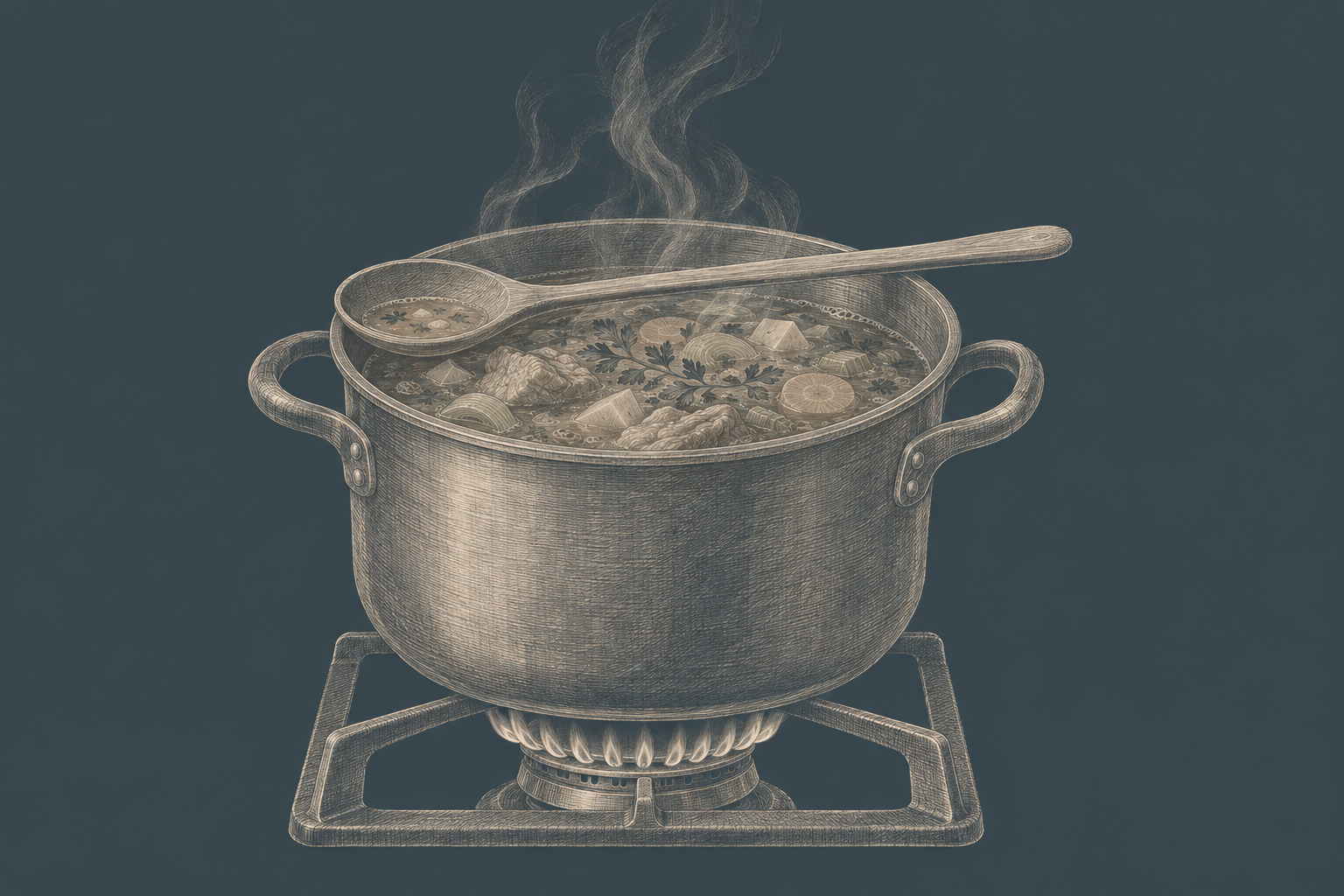
Seasoning a soup means checking the salt content, not the volume of liquid. Your body does the same thing with your blood.
When water is lacking, your blood becomes slightly more concentrated. Sensors in your brain, known as osmoreceptors, detect this change and trigger the release of a hormone that tells your kidneys to hold onto water. This hormone is called vasopressin, or antidiuretic hormone, ADH for short. As a result, you produce less urine, and it becomes darker (Thornton, 2010). The kidneys can only delay the need to drink for so long, though (Popkin et al., 2010). And that is precisely why thirst exists.
Thirst is, in reality, a late signal. Your body is already conserving water through the kidneys before you feel it clearly. But late doesn't mean too late in everyday life. How late is late? Researchers don't entirely agree. In an older study involving eight healthy women, thirst only set in once the blood was already noticeably more concentrated than the point at which the hormone had kicked in (Spruce et al., 1985). A systematic review from London, published in 2018, which analysed twelve studies involving a combined 167 healthy and unwell participants, found instead that thirst and the hormonal response set in at almost the same point. From there, thirst grew steadily stronger as blood concentration increased. Both thresholds fell in the middle of the normal range (Hughes et al., 2018). According to this analysis, thirst makes itself known while your blood values are still completely normal. If you're healthy, spending your day at the office or at home, and it's not 30 degrees outside, then in my view it's perfectly sufficient to drink with your meals and whenever you feel thirsty.
How Confident Am I, Really?
I like to sort what I know the way a traffic light works. When it comes to drinking, two of its colours are lit. Green, for me, goes to findings that many independent research groups have measured and confirmed. That the body regulates its own fluid balance is one of them. The sensors, the hormone, and the kidneys' response have been verified in experiment after experiment for decades. As far as I'm concerned, that counts as established.
Yellow marks a conclusion that follows logically from what is established, but that nobody has tested directly yet. That you can get through an ordinary day without a drinking schedule is one such conclusion, and I call it plausible. The case for it rests on the regulatory mechanism itself and on nutritional surveys covering thousands of adults who were clearly healthy without hitting any particular target (Valtin, 2002). What's missing is a direct comparison. As recently as 2010, there was no long-term randomised trial on drinking behaviour (Popkin et al., 2010). When a research group from San Francisco counted things up in 2024, they found 18 randomised studies in which people deliberately changed how much they drank, but described the quantity and quality of that evidence as limited themselves (Hakam et al., 2024). A trial in which healthy people drink either by thirst or by schedule over several years is something I have not come across. That is why my confidence light stays on yellow here, even though I am personally convinced by the argument.
Does Coffee Count? What About Food?
Coffee counts. A British study gave 50 men who already drank three to six cups a day four cups of coffee at 200 millilitres each for three consecutive days, and in a second round the same volume of water instead. Urine output over 24 hours came in at 2,409 millilitres with coffee and 2,428 with water. Total body water and blood values showed no difference either (Killer et al., 2014). The study was funded by a coffee industry institute. I don't find that objectionable (someone has to pay for this kind of research), but you deserve to know it. What does this mean for you if you're a woman or only drink coffee occasionally? Strictly speaking, nothing, because the study looked only at men who were accustomed to caffeine. Valtin had already reached the same conclusion years earlier in his review (Valtin, 2002). Whether coffee agrees with you personally is a different question, and it doesn't have the same answer for everyone. According to blood type nutrition, blood type AB tolerates it well, while blood type O is better off avoiding it. Christine and I cover what suits your blood type in our blood type courses.
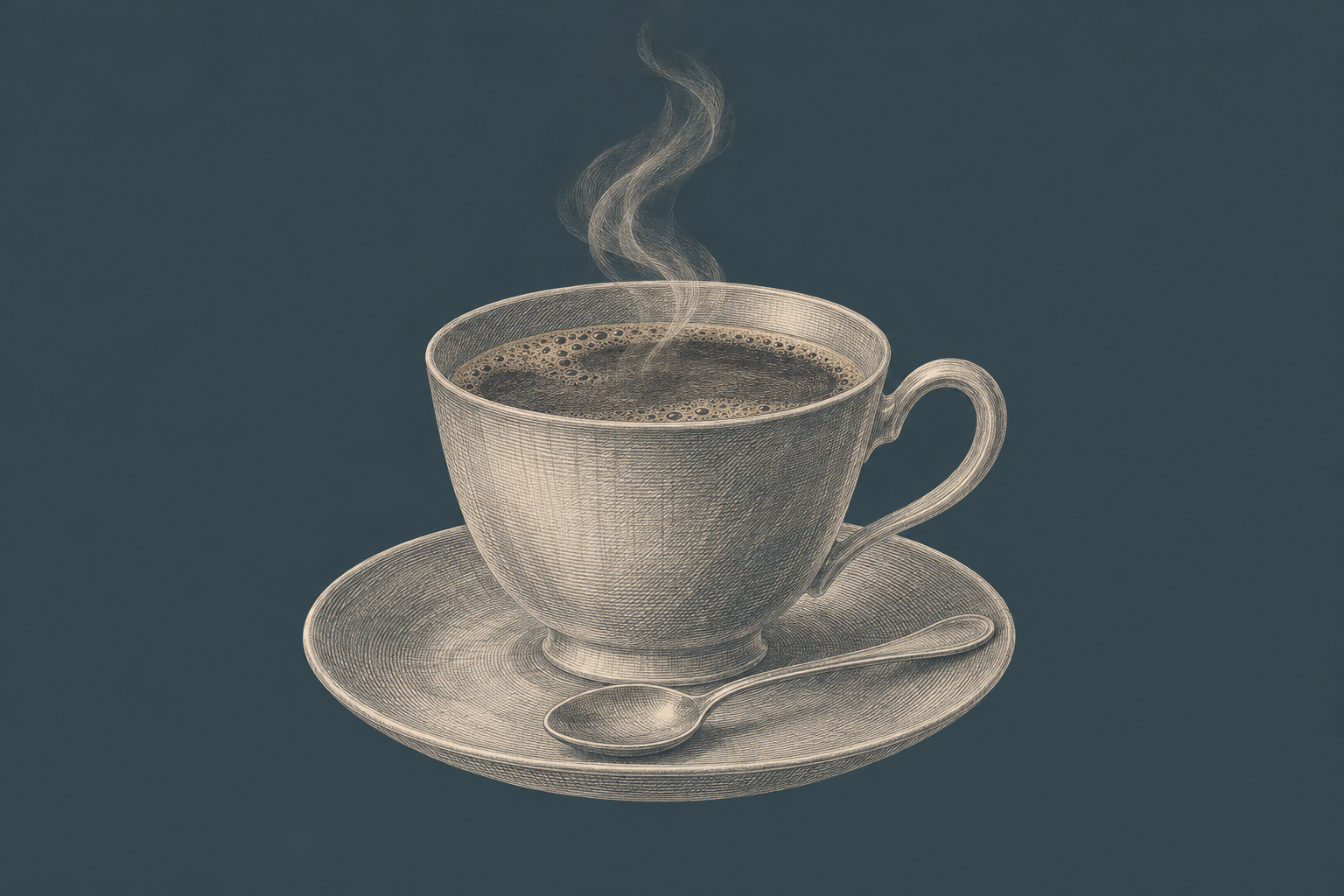
Four cups of coffee a day did not alter the fluid balance of 50 habitual coffee drinkers (Killer et al., 2014).
Food counts too. In the DGE's calculations, one third of daily water intake comes from solid food (DGE, Referenzwert Wasser). With plenty of fruit and vegetables on your plate, that share goes up. Strawberries, watermelon, lettuce and spinach are over 90% water; apples, oranges and yoghurt over 80% (Popkin et al., 2010). If you have a soup and a salad for lunch, you've already taken in a fair amount of water without touching your water bottle once.
When Does Thirst Actually Come Too Late?
The correct half of that statement applies to a handful of specific situations. Valtin explicitly limited his conclusion to healthy adults living in a temperate climate with low levels of physical activity (Valtin, 2002). Outside those boundaries, you're better off drinking before thirst sets in.
- When you're sweating hard for an extended period. During exercise and in summer heat, we humans only partially replace fluid losses through drinking, and with a delay. Researchers call this involuntary dehydration (Greenleaf, 1992). Drink before your workout, and during longer sessions, drink regularly throughout.
- When you have a fever, diarrhea, or are vomiting. In these situations, your fluid requirements increase (DGE, Referenzwert Wasser). If you can't keep anything down, that's a matter for a doctor.
- In older age. As the years go by, the thirst signal grows quieter. In a small trial, 7 healthy men between 67 and 75 years old and 7 men between 20 and 31 went without water for a full day. Afterwards, the older men reported less thirst and drank less, even though their blood was more concentrated than that of the younger group (Phillips et al., 1984).
If your parents are already at that age, feel free to put an extra glass of water in front of them on hot days. If their doctor has prescribed a specific fluid intake because of heart or kidney conditions, that recommendation takes precedence, of course. And what about your kids? Valtin's conclusion applies to adults. During sport and in the heat, children often don't recognise that they need to replace fluids (Popkin et al., 2010). When they're running around outside in summer or at training, I'd offer them something to drink without waiting to be asked. For children's everyday fluid needs outside those situations, I'm not aware of any research that addresses the question directly.
Recurring urinary tract infections or a history of kidney stones are a different matter. There, the issue isn't thirst. It's prevention. A structured drinking plan is well justified in both cases. In one study, 140 premenopausal women who had experienced at least three urinary tract infections in the previous year and were drinking less than 1.5 litres a day either continued as usual or added 1.5 litres of water daily for a year. With the additional water, they had an average of 1.7 infections compared to 3.2 in the control group (Hooton et al., 2018). That study was funded by the research division of Danone, a company that also sells mineral water. Four of the seven authors were employed there. For kidney stones, a 2024 review draws on an Italian study involving people who had already passed their first calcium-containing kidney stone. Five years later, 12 of 99 participants who drank plenty of water had developed a new stone, compared to 27 of 100 in the comparison group (Borghi et al., 1996; Hakam et al., 2024). How much you should drink in that situation is something to work out with your doctor. The role that oxalate from spinach and other vegetables plays in kidney stone formation is something I've covered in the article on antinutrients.
What Does the Colour of Your Urine Tell You?
The rest you can find out with a quick glance into the toilet bowl. Because vasopressin tells the kidneys to conserve water, urine becomes more concentrated and therefore darker the moment your body is running low. American researchers compared urine colour against more precise measurements in two laboratory trials and one field study, finding that it correlates closely with urinary concentration. Where a rough estimate is good enough (on the sports field or at work), the authors consider urine colour a serviceable indicator; for laboratory purposes, they found it too imprecise (Armstrong et al., 1994). In practical terms: pale yellow means you're on track, and dark yellow means it's time for a glass of water.
Can you drink too much water?
The warning about drinking too much water has a real basis, but it rarely applies to everyday life. Your kidneys can only excrete a limited amount of water in any given hour. In a South African study, six healthy people at rest drank between 0.9 and 1.8 litres per hour over three hours, while their kidneys managed a peak output of 778 millilitres per hour. The remainder stayed in the body and diluted the blood, causing sodium levels to drop from 144 to 136 millimoles per litre (Noakes et al., 2001). When blood sodium falls too far, doctors call it hyponatraemia. It can be life-threatening.
Where does this actually happen? It is best known from prolonged endurance events. At the 2002 Boston Marathon, 13% of the 488 runners examined at the finish line had sodium levels that were too low. Those most affected were runners who had gained weight during the race, meaning they had taken in more fluid than they had lost through sweat. The same applied to anyone who had been on the course for more than four hours (Almond et al., 2005). Someone sitting at a desk and drinking to thirst will never come close to those volumes. For me, hyponatraemia is still a good argument against the idea that more is always better. The role salt plays in all of this, and why a drink containing some sodium makes more sense than plain water during longer training sessions, is covered in the article "Water & Hydration" on Naviyara, our nutrition app. It is currently only available in English.
What does this mean for your everyday life?
All of this adds up to a simple order of things, no checklist required, and no reason to feel guilty about it.
- Drink with your meals and whenever you're thirsty. Whether you reach for tap water, mineral water, or unsweetened tea is entirely a matter of taste. If your drink has an ingredients list, it's worth a look at the back. I'll show you how to read one in the article "Reading the Ingredients List".
- Count your coffee and your food. Soup, salad, and fruit all contribute water, and so does every cup of coffee.
- Check the colour. Light yellow means you're doing fine. Dark yellow means it's time for a glass of water.
- Drink ahead of time when you're sweating or unwell. That applies to exercise, summer heat, fever, and diarrhoea.
- Keep an eye on the older members of your family. Their sense of thirst is quieter than yours.
The half-empty water bottle on your desk isn't a sign that you've fallen short. It simply means your body didn't ask for more that day. If you enjoy working with a drinking schedule, I'm not going to talk you out of it. You don't need one to stay healthy, though. And for every healthy adult at your table, thirst is a signal you can trust.
More on hydration at Naviyara. Naviyara is the nutrition app from our team. It evaluates meals, foods, and ingredients lists by scan and explains the reasoning every time. The app comes with a knowledge library, and that's where you'll find the article "Water & Hydration". It goes deeper into what I've only touched on here, covering electrolytes, drinking during exercise lasting more than an hour, hydration at altitude, and on long flights. The article is freely accessible and currently available in English only.
FAQ
How much water should I drink per day? There is no fixed number that works for everyone. For adults between 25 and 51, the DGE recommends around 1.4 litres from beverages as a guideline, under average living conditions. If you are healthy and not sweating heavily, my view is that drinking with meals and when you are thirsty is enough.
Is it true that by the time you feel thirsty, it is already too late? In everyday life, it is not. Thirst is a late signal, because your body starts conserving water through the kidneys before it kicks in. That said, a review of twelve trials found that thirst sets in while blood values are still within the middle of the normal range (Hughes et al., 2018). It does come too late during heavy sweating, fever, diarrhoea, or in older age. In those situations, it is better to drink ahead of time.
Does coffee count towards your fluid intake? Yes. In a study of 50 habitual coffee drinkers, four cups a day had no effect on fluid balance compared with the same amount of water (Killer et al., 2014). Worth noting: only men were studied, and the work was funded by a coffee industry institute.
How do I know if I am not drinking enough? The simplest indicator is the colour of your urine. Pale yellow means your body has enough water. If it turns dark yellow and the volume drops, your kidneys are conserving water and it is time to drink something.
Do older people need to drink more? More than anything, they need to drink more regularly, because their sense of thirst becomes quieter with age. In one trial, men between 67 and 75 reported less thirst after a day without water than younger men did, even though their blood was more concentrated (Phillips et al., 1984). If a doctor has prescribed a specific fluid intake, that takes precedence.
Can drinking too much water be dangerous? Yes, if you drink more in a short period than your kidneys can excrete. One trial put that threshold at just under 0.8 litres per hour (Noakes et al., 2001). When that happens, sodium levels in the blood drop. This has occurred mainly during prolonged endurance events such as a marathon.
References
- Valtin H. "Drink at least eight glasses of water a day." Really? Is there scientific evidence for "8 x 8"? Am J Physiol Regul Integr Comp Physiol. 2002;283(5):R993–1004. PubMed 12376390
- Vreeman RC, Carroll AE. Medical myths. BMJ. 2007;335(7633):1288–9. PubMed 18156231
- DGE, Referenzwert Wasser (dge.de)
- Popkin BM, D'Anci KE, Rosenberg IH. Water, hydration, and health. Nutr Rev. 2010;68(8):439–58. PubMed 20646222
- Thornton SN. Thirst and hydration: physiology and consequences of dysfunction. Physiol Behav. 2010;100(1):15–21. PubMed 20211637
- Spruce BA, Baylis PH, Burd J, Watson MJ. Variation in osmoregulation of arginine vasopressin during the human menstrual cycle. Clin Endocrinol (Oxf). 1985;22(1):37–42. PubMed 3978827
- Hughes F, Mythen M, Montgomery H. The sensitivity of the human thirst response to changes in plasma osmolality: a systematic review. Perioper Med (Lond). 2018;7:1. PubMed 29344350
- Hakam N, Guzman Fuentes JL, Nabavizadeh B, Sudhakar A, Li KD, Nicholas C, et al. Outcomes in Randomized Clinical Trials Testing Changes in Daily Water Intake: A Systematic Review. JAMA Netw Open. 2024;7(11):e2447621. PubMed 39585691
- Killer SC, Blannin AK, Jeukendrup AE. No evidence of dehydration with moderate daily coffee intake: a counterbalanced cross-over study in a free-living population. PLoS One. 2014;9(1):e84154. PubMed 24416202
- Greenleaf JE, New Collective Author. Problem: thirst, drinking behavior, and involuntary dehydration. Med Sci Sports Exerc. 1992;24(6):645–56. PubMed 1602937
- Phillips PA, Rolls BJ, Ledingham JG, Forsling ML, Morton JJ, Crowe MJ, et al. Reduced thirst after water deprivation in healthy elderly men. N Engl J Med. 1984;311(12):753–9. PubMed 6472364
- Hooton TM, Vecchio M, Iroz A, Tack I, Dornic Q, Seksek I, et al. Effect of Increased Daily Water Intake in Premenopausal Women With Recurrent Urinary Tract Infections: A Randomized Clinical Trial. JAMA Intern Med. 2018;178(11):1509–1515. PubMed 30285042
- Borghi L, Meschi T, Amato F, Briganti A, Novarini A, Giannini A. Urinary volume, water and recurrences in idiopathic calcium nephrolithiasis: a 5-year randomized prospective study. J Urol. 1996;155(3):839–43. PubMed 8583588
- Armstrong LE, Maresh CM, Castellani JW, Bergeron MF, Kenefick RW, LaGasse KE, et al. Urinary indices of hydration status. Int J Sport Nutr. 1994;4(3):265–79. PubMed 7987361
- Noakes TD, Wilson G, Gray DA, Lambert MI, Dennis SC. Peak rates of diuresis in healthy humans during oral fluid overload. S Afr Med J. 2001;91(10):852–7. PubMed 11732457
- Almond CS, Shin AY, Fortescue EB, Mannix RC, Wypij D, Binstadt BA, et al. Hyponatremia among runners in the Boston Marathon. N Engl J Med. 2005;352(15):1550–6. PubMed 15829535
Dr Holger Scheib is a chemist and Honorary Associate Professor at the University of Queensland. As “The HealthChemist” he translates research on ingredients and nutrition into plain language. More about me
Shall I send you the next article?
I write irregularly but thoroughly: new articles, honestly sorted into proven, plausible and hypothesis. No spam, no sales funnel.
Last updated: 16 November 2026