Ingredients
Reading the ingredient list: five words that mean nothing
The front of the pack is the promise, the back is the truth. A chemist explains which terms are legally protected, which are pure marketing, and in what order you should read.
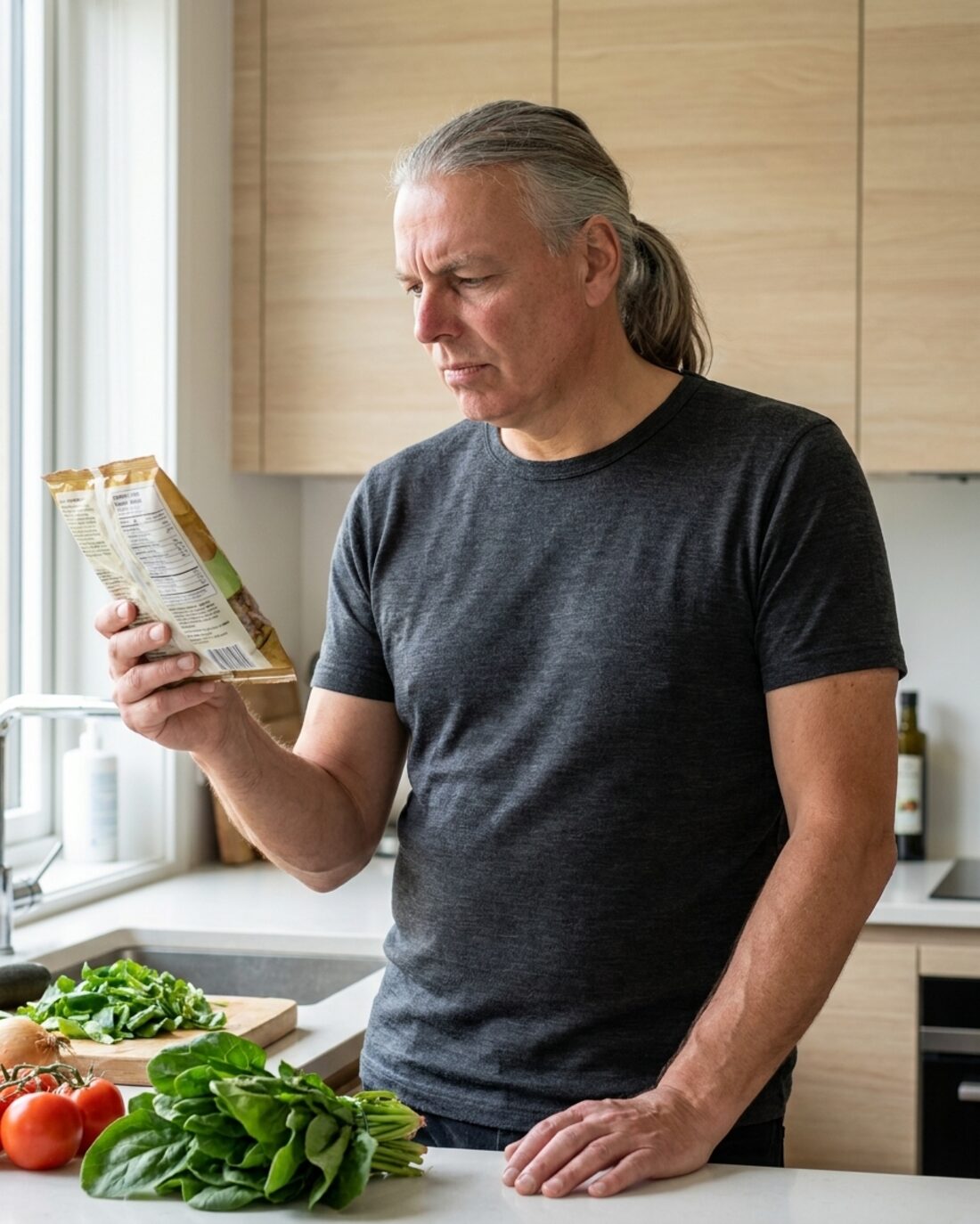
The front of a package is marketing. The back is chemistry.
The gap between the two is often surprisingly wide, and I am not claiming anyone is lying. I am only saying that the two sides play by entirely different rules: on the front you may claim almost anything that isn't expressly forbidden, while the back has to state what is actually inside, in an order laid down by law and sorted by quantity. Anyone who has understood that difference once is suddenly holding a different package than before.

The order is the information
Ingredients are listed in descending order of weight. That is not a convention, it is a rule. What comes first is present in the largest amount.
If sugar is in third place, there is more of it in the product than of any single item that follows. And if it sits far down the list, is the matter settled? Unfortunately not. It can still be plentiful, namely whenever it hides behind several names and spreads its true share across half the list. Glucose syrup, dextrose, maltodextrin, fructose-glucose syrup, invert sugar syrup, malt extract: six entries, six positions further down, and in total quite possibly still the main ingredient we meant to avoid. That is not a scandal. It is arithmetic you have to know.
In cosmetics the same list is called INCI, and there it gets tricky: the order only holds down to a share of one percent, and below that manufacturers may sort as they please. So where does the expensively advertised plant extract end up, the one the front of the bottle is built around? Usually right at the back, in the decimal range, long after the preservative.

Five words that guarantee nothing
"Natural." Not a protected term, no definition, no test. Hydrogen cyanide is natural. Botulinum toxin is natural, and it is one of the most potent poisons known. The word says something about where a substance comes from and nothing about what it does, and that is the whole trick. A molecule doesn't know whether it came from a plant or from a reaction vessel. It has the same structure and does the same thing.
"Chemical-free." There is no such thing as chemical-free. Water is a chemical, the air we breathe is chemistry, and we ourselves are made of nothing else from head to toe. Anyone advertising with this word really means "without the substances I have just frightened you about", and quietly hopes you won't ask which ones those are and why they are supposed to be bad.
"No added sugar." A precise phrase that means something other than most people understand. It means: we didn't add any. It does not mean: there is none. Fruit juice concentrate is not added sugar in the legal sense, and it is sugar in the body all the same.
"Dermatologically tested." Tested does not mean passed. It only means that someone had a look. What exactly was examined, on how many people and with what result, is something the package prudently keeps to itself.
"Clinically confirmed." The most interesting of all, because it sounds like real science. What was confirmed is as a rule tolerability, or a single measured value on a handful of subjects without a control group. That is not proof of efficacy in the medical sense, and it wouldn't have to be. It isn't a medicine, after all.
What is actually regulated
There are quite a few terms with real rules behind them. "Organic" is legally defined and controlled in the EU and in Switzerland, nutrition values per hundred grams are mandatory and therefore comparable, and allergens have to be highlighted in the text. Health claims, finally, meaning the statement that a substance does something particular in the body, may only go on a package if they have been officially approved. That is exactly why we so often meet that oddly bloodless phrase "contributes to the normal function of the immune system". It has been checked. It is permitted. And it promises a great deal less than the reader hears in it.
From this follows an observation I find quite intriguing: the vaguer a statement sounds, the more likely it has been checked. And the more concrete and dramatic it sounds, the more likely it stands on the front, where nobody ever had to check it.
How I read a package
First I turn it over. The front has never told me anything I didn't already suspect. Then I look for the first three ingredients, which together make up most of the product; everything after that is nuance. Then I count the kinds of sugar, not because sugar is a poison, it isn't, but because spreading it across many names makes the whole order unreadable, and that is precisely what I want to spot. And finally I check what sits behind the percentages: when a package advertises strawberries in large letters and the list then says "strawberry 3%", I know enough about the relationship between the picture and the contents.
And then? Then I ignore every single adjective.
What this does not mean
None of this means that convenience foods are bad, that additives harm us, or that manufacturers want to deceive us. Quite the opposite: the vast majority of additives are far better studied than most of the natural foods we could no longer separate them from anyway.
It means one thing only: the back holds more information than the front, and it costs you all of twenty seconds. Where others read advertising, I see a list of molecules. And then I decide for myself.
In the coming articles I take individual substances apart and sort every statement: proven, plausible or hypothesis. Starting with the ones the internet warns about loudest: the antinutrients in vegetables and legumes.
Dr Holger Scheib is a chemist and Honorary Associate Professor at the University of Queensland. As “The HealthChemist” he translates research on ingredients and nutrition into plain language. More about me
Shall I send you the next article?
I write irregularly but thoroughly: new articles, honestly sorted into proven, plausible and hypothesis. No spam, no sales funnel.
Last updated: 22 August 2026