Ingredients
Hidden Sugar: How to Find It on the Packaging
Sugar hides behind many names on the ingredients list. The "of which sugars" line adds them all up. Here's how to read it and spot what was added.
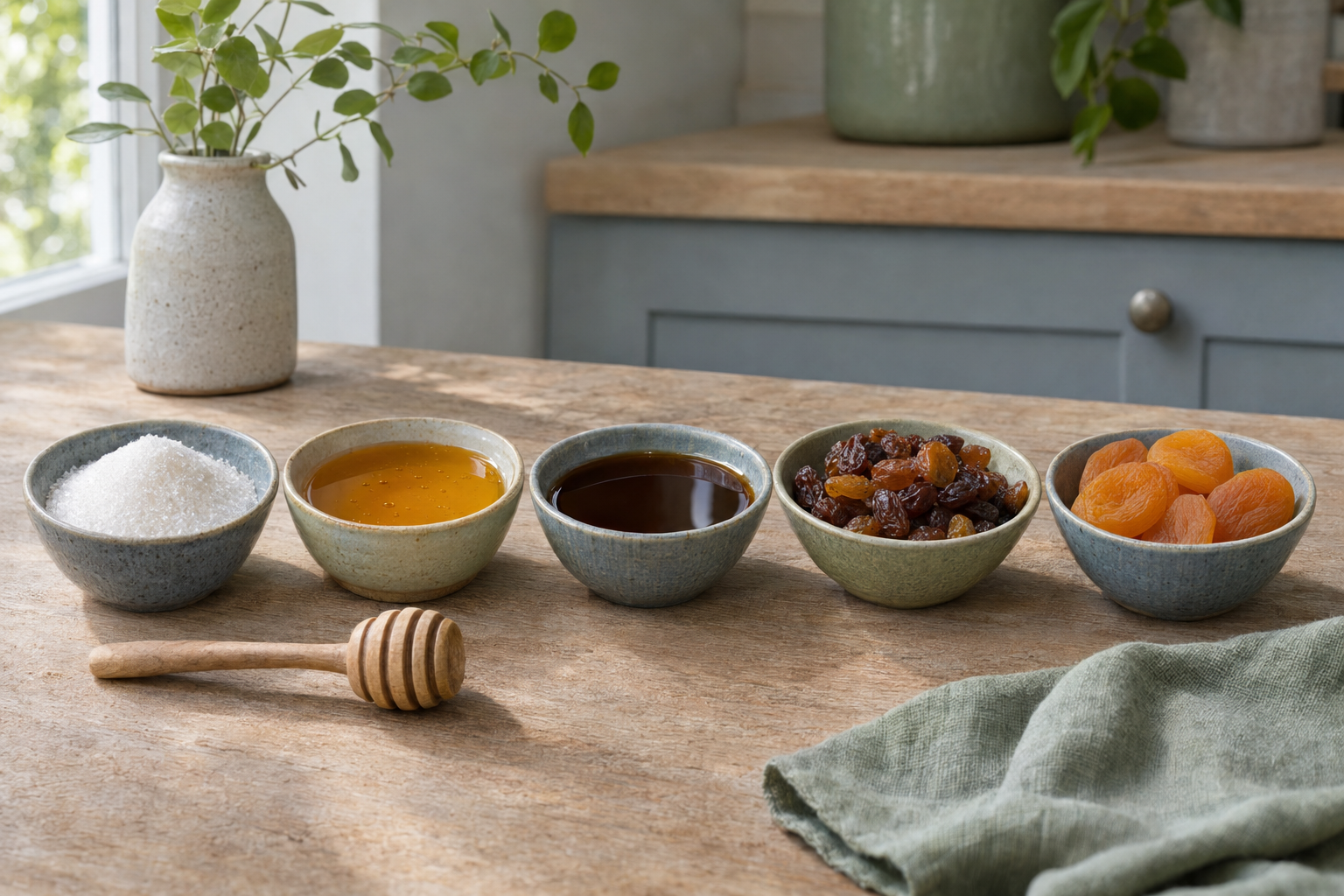
On the back of a crunchy granola pack, you might find glucose syrup, honey, apple juice concentrate, and barley malt extract listed without the word "sugar" appearing once. The manufacturer hasn't lied, every ingredient is named exactly as food law requires. But if you flip the pack over in the shop and go looking for sugar, you won't find it. Does that mean there isn't any?
Unfortunately not. That said, I wouldn't keep searching the ingredients list. A few centimetres over, you'll find the nutrition table, and under carbohydrates there's a line that reads "of which sugars." Every sugar in the product ends up in that line, regardless of what name it arrived under in the recipe. Sugar can hide behind many names in the ingredients list. In the nutrition table, it can't. That one figure, combined with a quick glance at the unsweetened version on the same shelf, will get you further in the shop than any list of sugar aliases ever could.
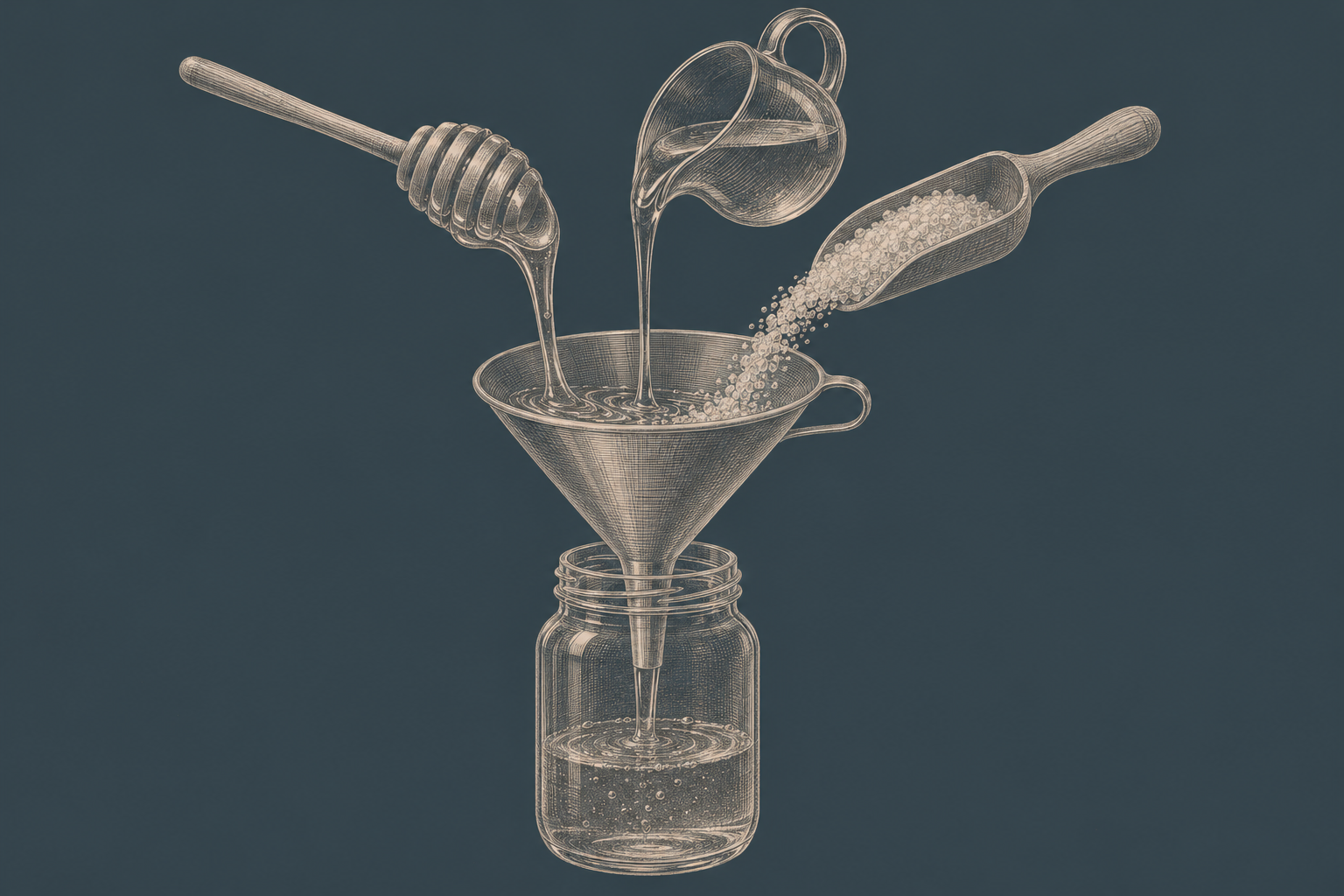
Many names, one line: in the nutrition table, every sweetener in a product flows into the same row.
> AT A GLANCE: Hidden sugar is sugar that appears in the ingredients list under other names, as dextrose, glucose-fructose syrup, honey, or juice concentrate, for example. In the nutrition table, all of these names converge in the "of which sugars" line, because EU food law counts every mono- and disaccharide in a product there. How much of it was added becomes clear when you compare with the unsweetened version. The 24 companies that committed to sugar reduction in Switzerland added a median of 7.7 g of sugar per 100 g to their fruit yoghurts in 2024 (FSVO, survey 2024). As of: November 2026.
Why Does Sugar So Rarely Appear as "Sugar" on the Label?
The ingredients list follows a straightforward rule: every ingredient must be listed under its own specific name (Regulation (EU) No 1169/2011, Article 18). The plain word "sugar" refers only to sucrose, the table sugar you keep in your kitchen (Annex VII of the same regulation). Glucose appears as dextrose, a syrup made from starch shows up as glucose syrup. Honey is listed as honey.
So the word "sugar" carries two different meanings on one and the same pack. In the ingredients list it refers to a single substance; in the nutrition table it covers an entire family of compounds. Anyone scanning the ingredients list for the word is really searching for sucrose, and will miss all its relatives in the process. No manufacturer needs to be clever about this. A muesli sweetened with honey and apple juice concentrate simply sounds friendlier than one made with sugar, even though both are correctly labelled.
What's actually behind all these names?
Nearly all of them come down to the same two molecules: Glucose and Fructose. Both are built from exactly the same atoms, six carbon, twelve hydrogen, and six oxygen (PubChem, CID 5793 and CID 2723872). Only the arrangement differs. As a chemist, I think of the words "silent" and "listen" (same letters, entirely different meaning). Fructose and Glucose behave in a surprisingly similar way on the tongue: Fructose tastes sweeter than table sugar, Glucose noticeably less so (Lebensmittelklarheit, 2023).
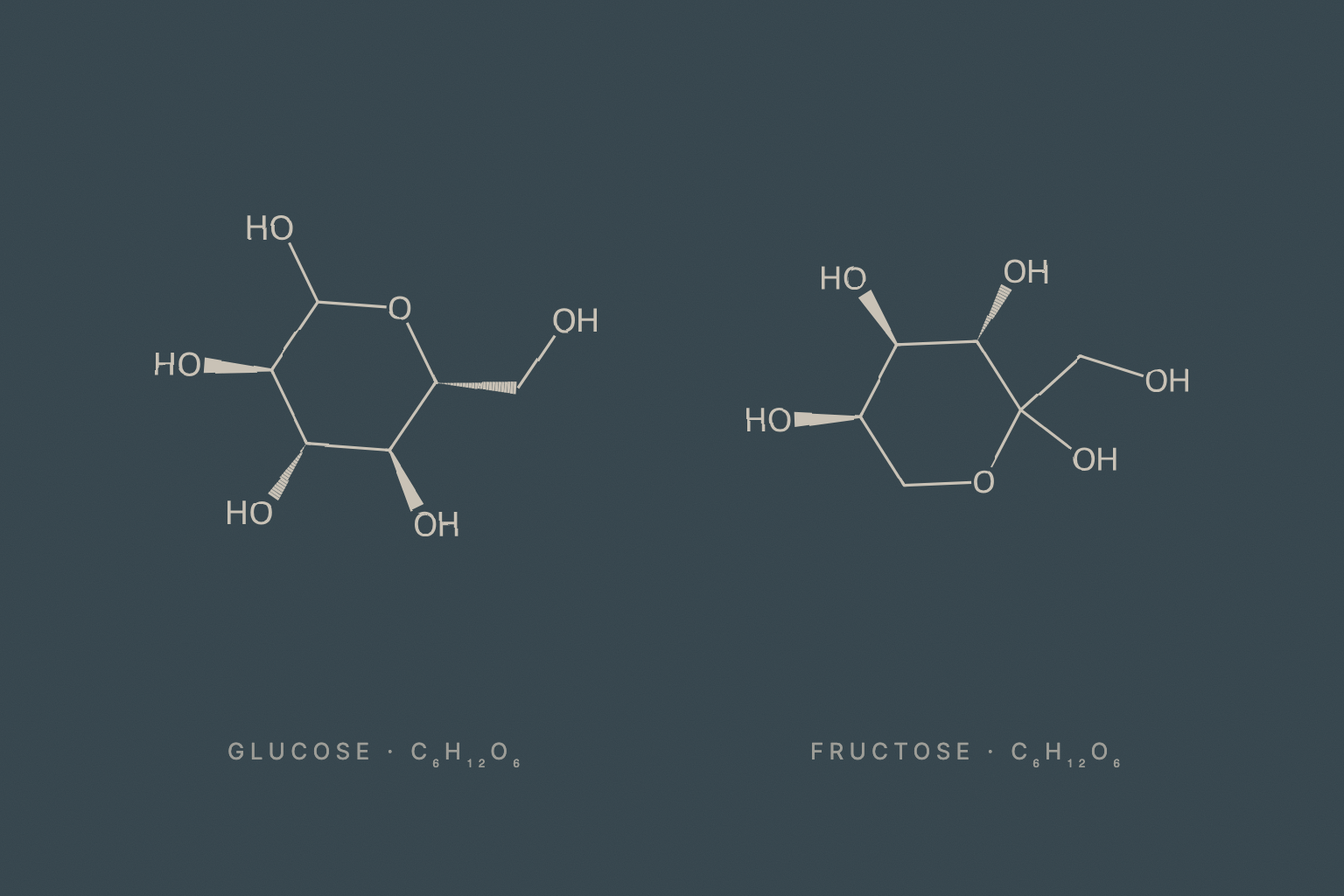
Glucose and Fructose are made of the same atoms (C₆H₁₂O₆). Only their arrangement sets them apart.
Sucrose is a disaccharide: one Glucose molecule and one Fructose molecule bonded together. When that bond is broken, the result is invert sugar, in which Fructose and Glucose are present in roughly equal parts (Directive 2001/111/EC). Most of the other sweeteners you find on an ingredients list are simply mixtures of those same two building blocks, just in varying proportions.
| Name on the label | What it actually is |
|---|---|
| Sugar | Sucrose, made up of equal parts Glucose and Fructose |
| Dextrose, grape sugar | pure Glucose |
| Glucose syrup | sugars derived from starch in concentrated solution |
| Glucose-fructose syrup, fructose-glucose syrup | Glucose syrup with more than 5% Fructose in dry matter; the sugar named first is the dominant one |
| Invert sugar syrup | split Sucrose; Fructose and Glucose in roughly a 1:1 ratio |
| Honey | primarily Fructose and Glucose (Directive 2001/110/EC) |
| Agave syrup | predominantly Fructose; across 19 Mexican agave syrups, it averaged 84% of total sugars (Willems and Low, 2012) |
| Apple juice concentrate | the sugars of apple juice with the water removed: Fructose, Glucose, and Sucrose (Lee and Wrolstad, 1988) |
| Lactose, milk sugar | the disaccharide found in milk |
| Maltodextrin | short chains of Glucose that taste barely sweet (Hofman et al., 2016) |
The entries from dextrose through invert sugar syrup are drawn from the EU sugar directive. You don't need to memorise this table. It's here to show you that behind all those appealing names, the same building blocks keep turning up, and those are exactly the ones your nutrition label adds together.
Why the Order of Ingredients Tells You So Little About the Sugar
Ingredients are listed in descending order by weight, measured at the time of production. In the article "Reading the Ingredients List", I described why I count the types of sugar on a pack. Splitting them across many names is exactly what makes that order unreadable. A quick calculation shows how that works.
Take a muesli that contains, per 100 g, 50 g oats, 20 g sweetener, 12 g nuts, 10 g raisins and 8 g other ingredients. If the sweetener comes from a single source, it appears in second place, right after the oats. But if the manufacturer spreads those same 20 g across four sweeteners at 5 g each, every single one drops below the nuts and the raisins. On the scales, the sugar weighs exactly the same whether it sits in one bowl or four. It just looks like less on the ingredients list.
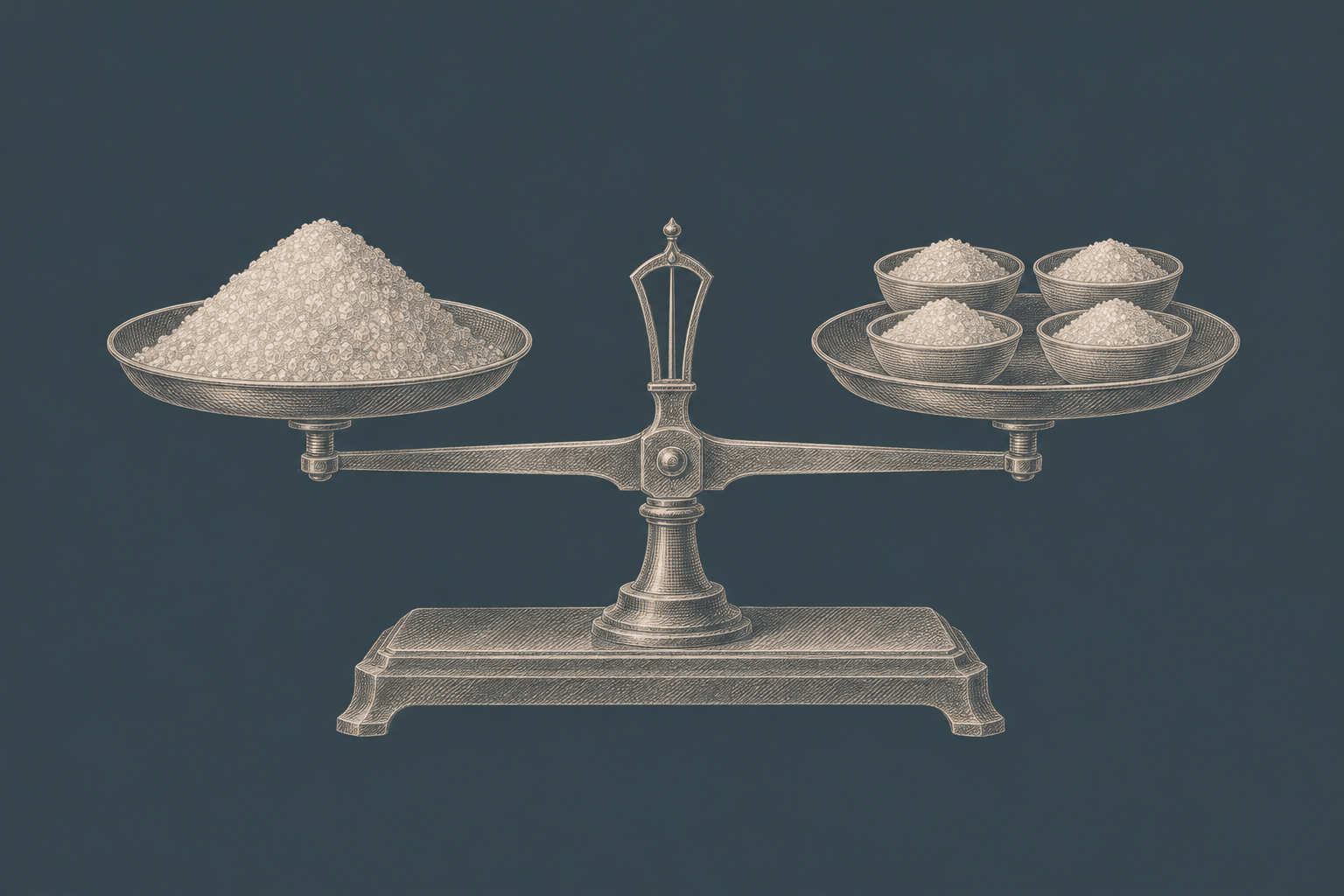
The same amount of sugar, once in one bowl and once in four. The ingredients list only shows the individual bowls.
Whether a manufacturer does this deliberately or simply combines different sweeteners for reasons of taste and texture, I cannot judge from the outside. For you in the shop, it makes no difference either way. On top of that, there are two quirks in the regulation worth knowing. Ingredients that make up less than 2% of the product may appear at the end of the list in any order. And a percentage declaration is required mainly for ingredients that are highlighted in the product name, image or text on the pack. As far as I can tell, hardly any pack advertises its sugar content. The ingredients list will tell you which sweeteners are in the product. How much there is in total, it will not tell you.
What actually counts towards the "of which sugars" line?
The definition sits in Annex I of the regulation, and it is refreshingly short. "Sugars" means "all monosaccharides and disaccharides present in food, but excluding polyols" (Regulation (EU) No 1169/2011). Monosaccharides are simple sugars such as Glucose and Fructose; disaccharides are double sugars such as sucrose and lactose. Switzerland has adopted this definition in almost identical wording in its own food law (LIV, Annex 1).
The word "present" is the one that matters, because the line counts what ends up in the finished product, regardless of how it got there. The sugar from honey counts just as much as the sugar from apple juice concentrate, and the lactose in yoghurt just as much as the Fructose in raisins. Sugar content is a mandatory entry in the nutrition table and must be declared per 100 g or per 100 ml; a per-serving figure is something manufacturers may add on top, but are not required to. I would always read the per-100-g column anyway, because that is the only column that lets you compare two different products side by side. A British analysis of breakfast cereals put a typical serving at 30 g (Pombo-Rodrigues et al., 2017). How many of us actually weigh out 30 g in the morning?
Longer sugar chains, however, do not show up in that line, because it only counts mono- and disaccharides. The most important example is maltodextrin. The Glucose from maltodextrin is absorbed quickly in the small intestine (Hofman et al., 2016). In the nutrition table, maltodextrin almost always appears under total carbohydrates rather than under "of which sugars." When maltodextrin sits high up in the ingredients list, the declared sugar content looks more favourable than the product actually warrants, at least in my reading of it.
The nutrition table also makes no distinction between the sugar a food naturally contains and the sugar that has been added to it. In the US, a separate line for added sugars is mandatory (Moore et al., 2018). The EU does not require one. I would genuinely like to see it on every pack here too. Until that changes, a simple comparison is your most reliable tool.
How do you know how much sugar was added?
The comparison is usually right there on the same shelf, in the form of the unsweetened version. Let's work through the numbers using yoghurt as an example. A British research group analysed the nutritional information of 921 yoghurt products from five major online supermarkets in November 2016. Plain yoghurt contained a median of 5.0 g of sugar per 100 g, mostly lactose, while fruit yoghurt came in at 11.9 g (Moore et al., 2018). The difference of around 7 g comes from the fruit and from whatever was added to sweeten it. In a 150 g pot, that works out to just over 10 g.
How much of that was actually added sugar is something the shelf alone can't tell you. A second figure from Switzerland helps here, because it comes directly from the recipes. There, the 24 companies that signed the Milan Declaration on sugar reduction report their products' added sugar content to the Federal Food Safety and Veterinary Office. For fruit yoghurt, the median in 2024 was 7.7 g per 100 g (FSVO, 2024 survey), which works out to around 11.5 g in a 150 g pot. The two figures come from different countries and different years, and they don't measure exactly the same thing. That they land so close together is, to my mind, a reasonable argument that the shelf comparison works well enough as a rule of thumb.
And how much is that in teaspoons? The WHO equates 25 g of sugar with roughly six teaspoons, which puts one teaspoon at just over 4 g (WHO, 2015). The British shelf comparison gives you about two and a half teaspoons per pot; the Swiss recipe data puts it at just under three.
The same comparison works in other aisles too.
| Product category | Sweetened version | Comparison on the same shelf |
|---|---|---|
| Yoghurt | Fruit yoghurt: 11.9 g sugar per 100 g (UK, 2016); of which added sugar per Swiss recipes: 7.7 g (2024) | Plain yoghurt: 5.0 g per 100 g, mostly lactose (UK, 2016) |
| Muesli and cereals | Crunchy granola: 11.8 g added sugar per 100 g; puffed and extruded cereals: 14.1 g (Switzerland, 2024) | Plain rolled oats for porridge, with or without added ingredients: 2.3 g added sugar per 100 g (Switzerland, 2024) |
| Carbonated soft drinks, no sweeteners | 7.0 g sugar per 100 ml (Switzerland, 2024), so 23 g in a 330 ml can | Water: 0 g |
All figures are medians. The British data come from the yoghurt survey (Moore et al., 2018), the Swiss figures from the Federal Office's monitoring report (FSVO, 2024 survey). In Germany, the Max Rubner Institute found a median of over 19 g of sugar per 100 g in crunchy cereals such as pillows, rings and pops in 2025 (MRI, 2025).
With drinks, the calculation is simplest of all, because the distinction between naturally occurring and added sugar barely matters there. 7.0 g per 100 ml sounds modest, but in a 500 ml bottle that adds up to 35 g. What does that mean over the course of a whole day? The WHO recommends keeping so-called free sugars below 10% of daily energy intake, which at 2,000 kilocalories works out to around 50 g per day (FSVO, sugar reduction). Free sugars, by the way, include not only everything added but also, explicitly, sugar from honey, syrups, fruit juices and fruit juice concentrates (WHO, 2015).
A median is, of course, only the midpoint of a shelf. Among the British fruit yoghurts, the range ran from 4.6 to 21.3 g of sugar per 100 g, which is exactly why it's worth taking a look at the specific pack you're holding in your hand.
Where sugar turns up elsewhere, in sauces, bread or plant-based dairy alternatives, you'll find an overview in Naviyara, our nutrition app. The article "Added Sugar" is currently available in English only.
What Do "No Added Sugar", "Low Sugar" and "Less Sweet" Actually Mean?
On the front of the pack, you'll come across sugar-related claims that sound similar but sit far apart in legal terms. Four of them are defined in the annex to the EU's Health Claims Regulation (Regulation (EC) No 1924/2006). The first three appear with the same threshold values in Swiss law as well (LIV, Annex 13).
| Claim on the pack | What it legally means |
|---|---|
| sugar-free | no more than 0.5 g of sugars per 100 g or 100 ml |
| low sugar | no more than 5 g of sugars per 100 g, or no more than 2.5 g per 100 ml for liquids |
| no added sugar | no added mono- or disaccharides and no other food used for its sweetening properties |
| reduced sugar | at least 30% less sugar than a comparable product, at the same or lower energy value |
| less sweet | not defined in the regulation |
"Low sugar" sounds modest and yet sets a high bar, one that a plain natural yoghurt with 5.0 g just about clears. Of 101 yoghurts and fresh cheese products for children surveyed in a UK study, exactly two made it (Moore et al., 2018).
"No added sugar" is probably the most widely misunderstood claim of the lot. It means nothing was added to sweeten the product, no honey, no fruit syrup. What it says nothing about is the sugar the ingredients bring along naturally. In a fruit muesli, the dried fruit alone contains substantial amounts of sugar. For cases like this, the regulation provides for the note "contains naturally occurring sugars", which is actually mandatory in Switzerland. Sweeteners and sugar substitutes such as maltitol remain permitted (Lebensmittelklarheit, 2026). Whether a particular fruit or juice concentrate in a product is there primarily to sweeten it is, in my reading, something that can be argued case by case. Fortunately, you don't have to settle that argument yourself. The answer is right there in the nutrition table.
And "less sweet"? Consumer advice centres classify this as a pure taste claim that leaves open exactly how much sugar has been saved (Lebensmittelklarheit, 2023). A product can taste less sweet and still deliver exactly the same amount of carbohydrates, for instance when part of the sugar has been replaced with maltodextrin. Remember glucose, which tastes noticeably less sweet than table sugar? It can be used to make a product less sweet without removing a single gram of sugar.
What does this mean for your next shopping trip?
You don't need to memorise the names from the table or the threshold values. At the shop, four steps are enough.
- Turn the packaging over and go straight to the nutrition table. Read the line "of which sugars" in the per 100 g or per 100 ml column. I'd ignore the serving column entirely.
- Compare with the unsweetened version. Put the plain yoghurt next to the fruit yoghurt, and the rolled oats next to the crunchy granola. The difference is your rough estimate of everything added through fruit and sweetening.
- Only then look at the ingredients list. It tells you which sweeteners are in the product. If maltodextrin appears near the top, the sugar line alone isn't telling you the full story for that product.
- Translate the front-of-pack claims into a number. What "no added sugar" or "less sweet" actually means for any given product comes back to that same line: "of which sugars".
So how harmful is added sugar, really? Robert Lustig, a paediatrician and hormone specialist at the University of California, San Francisco, considers it harmful enough in the quantities we eat today that he would regulate it much like alcohol (Lustig et al., 2012). The European Food Safety Authority is more cautious in its wording. In 2022, however, it was unable to identify any level of sugar intake, within the amounts people typically consume, below which the risk of tooth decay and metabolic disease stops rising, and therefore recommends keeping added and free sugar as low as possible within a balanced diet (EFSA, 2022). I think that advice is sound. Whether the fruit yoghurt is worth those two and a half to three teaspoons to you is your call. What matters to me is that you make that decision with the number in hand, rather than leaving it to the front of the pack. Whether yoghurt suits you at all is a separate question. According to blood type nutrition, blood types B and AB tolerate it well, while type 0 is better off avoiding it. Christine and I cover what works for each blood type in our blood type courses.
Naviyara, our nutrition app. If you'd rather not do this translation work yourself every time you pick up a product, Naviyara can help. You photograph a label, an ingredients list or your plate, and the app rates what matters to you across five levels, explaining its reasoning in plain language. The idea is to keep you company until you can read most packaging without it. You should know that Naviyara is a product of my company. The first 30 days are free and include one scan per day for a meal, a food product and a cosmetic product; after that, the app runs as a subscription. You can currently request access via the contact form at naviyara.com/app. The website is currently available in English only.
FAQ
Is dextrose the same as sugar? Dextrose is glucose, plain and simple. On an ingredients list it appears under its own name; on the nutrition label it counts fully towards the "of which sugars" line. It tastes less sweet than table sugar but delivers the same amount of energy (Lebensmittelklarheit, 2023).
Does the sugar from fruit and milk count towards the "of which sugars" line? Yes. That line captures every mono- and disaccharide present in the product. That includes fructose from fruit and lactose from milk, just as much as any added sugar. Which is why a plain natural yoghurt shows around 5 g of sugar per 100 g, even though nobody has added a single gram.
Is maltodextrin a sugar? Legally, for the most part, no. Maltodextrin consists of short glucose chains, and the nutrition label only counts mono- and disaccharides as sugars. That said, the glucose from maltodextrin is absorbed rapidly in the small intestine (Hofman et al., 2016).
What does "naturally contains sugar" mean? This note goes hand in hand with the claim "no added sugar." It tells you that while nothing has been added to sweeten the product, the ingredients themselves bring sugar along, fruit or milk, for instance. How much exactly is in the nutrition table.
Is honey or agave syrup better than table sugar? On the nutrition label it makes no difference, because the sugar from both counts fully towards the "of which sugars" line. Honey consists mainly of fructose and glucose; agave syrup is predominantly fructose. Whether honey behaves differently in the body is a separate question. A 2023 analysis of 18 controlled studies found slightly more favourable blood glucose and blood lipid values, but rated the certainty of those findings as mostly low (Ahmed et al., 2023).
How much sugar per day is reasonable? The WHO recommends keeping free sugars below 10% of daily energy intake. At 2,000 kilocalories that works out to around 50 g. A further reduction to below 5%, roughly 25 g, has been issued as a conditional recommendation. This refers to added sugars as well as the sugar in honey, syrups and fruit juices. The sugar naturally present in whole fruit, vegetables and milk is explicitly excluded (WHO, 2015).
References
- FSVO, survey 2024 (blv.admin.ch)
- Regulation (EU) No 1169/2011 (eur-lex.europa.eu)
- PubChem, CID 5793 (pubchem.ncbi.nlm.nih.gov)
- CID 2723872 (pubchem.ncbi.nlm.nih.gov)
- Lebensmittelklarheit, 2023 (lebensmittelklarheit.de)
- Directive 2001/111/EC (eur-lex.europa.eu)
- Directive 2001/110/EC (eur-lex.europa.eu)
- Willems JL, Low NH. Major carbohydrate, polyol, and oligosaccharide profiles of agave syrup. Application of this data to authenticity analysis. J Agric Food Chem. 2012;60(35):8745–54. PubMed 22909406
- Lee HS, Wrolstad RE. Apple juice composition: sugar, nonvolatile acid, and phenolic profiles. J Assoc Off Anal Chem. 1988;71(4):789–94. PubMed 3417603
- Hofman DL, van Buul VJ, Brouns FJ. Nutrition, Health, and Regulatory Aspects of Digestible Maltodextrins. Crit Rev Food Sci Nutr. 2016;56(12):2091–100. PubMed 25674937
- LIV, Annex 1 (fedlex.admin.ch)
- Pombo-Rodrigues S, Hashem KM, He FJ, MacGregor GA. Salt and sugars content of breakfast cereals in the UK from 1992 to 2015. Public Health Nutr. 2017;20(8):1500–1512. PubMed 28166847
- Moore JB, Horti A, Fielding BA. Evaluation of the nutrient content of yogurts: a comprehensive survey of yogurt products in the major UK supermarkets. BMJ Open. 2018;8(8):e021387. PubMed 30228100
- WHO, 2015 (who.int)
- MRI, 2025 (mri.bund.de)
- FSVO, sugar reduction (blv.admin.ch)
- Regulation (EC) No 1924/2006 (eur-lex.europa.eu)
- Lebensmittelklarheit, 2026 (lebensmittelklarheit.de)
- Lustig RH, Schmidt LA, Brindis CD. Public health: The toxic truth about sugar. Nature. 2012;482(7383):27–9. PubMed 22297952
- EFSA Panel on Nutrition, Novel Foods and Food Allergens (NDA), Turck D, Bohn T, Castenmiller J, de Henauw S, Hirsch-Ernst KI, et al. Tolerable upper intake level for dietary sugars. EFSA J. 2022;20(2):e07074. PubMed 35251356
- Ahmed A, Tul-Noor Z, Lee D, Bajwah S, Ahmed Z, Zafar S, et al. Effect of honey on cardiometabolic risk factors: a systematic review and meta-analysis. Nutr Rev. 2023;81(7):758–774. PubMed 36379223
Dr Holger Scheib is a chemist and Honorary Associate Professor at the University of Queensland. As “The HealthChemist” he translates research on ingredients and nutrition into plain language. More about me
Shall I send you the next article?
I write irregularly but thoroughly: new articles, honestly sorted into proven, plausible and hypothesis. No spam, no sales funnel.
Last updated: 16 November 2026