Nutrition
Orange juice at breakfast: why you're hungry by 10:30
"100% fruit" is accurate, and yet you're hungry at half past ten. I'll show you what gets lost during pressing and which breakfast keeps you full for longer.
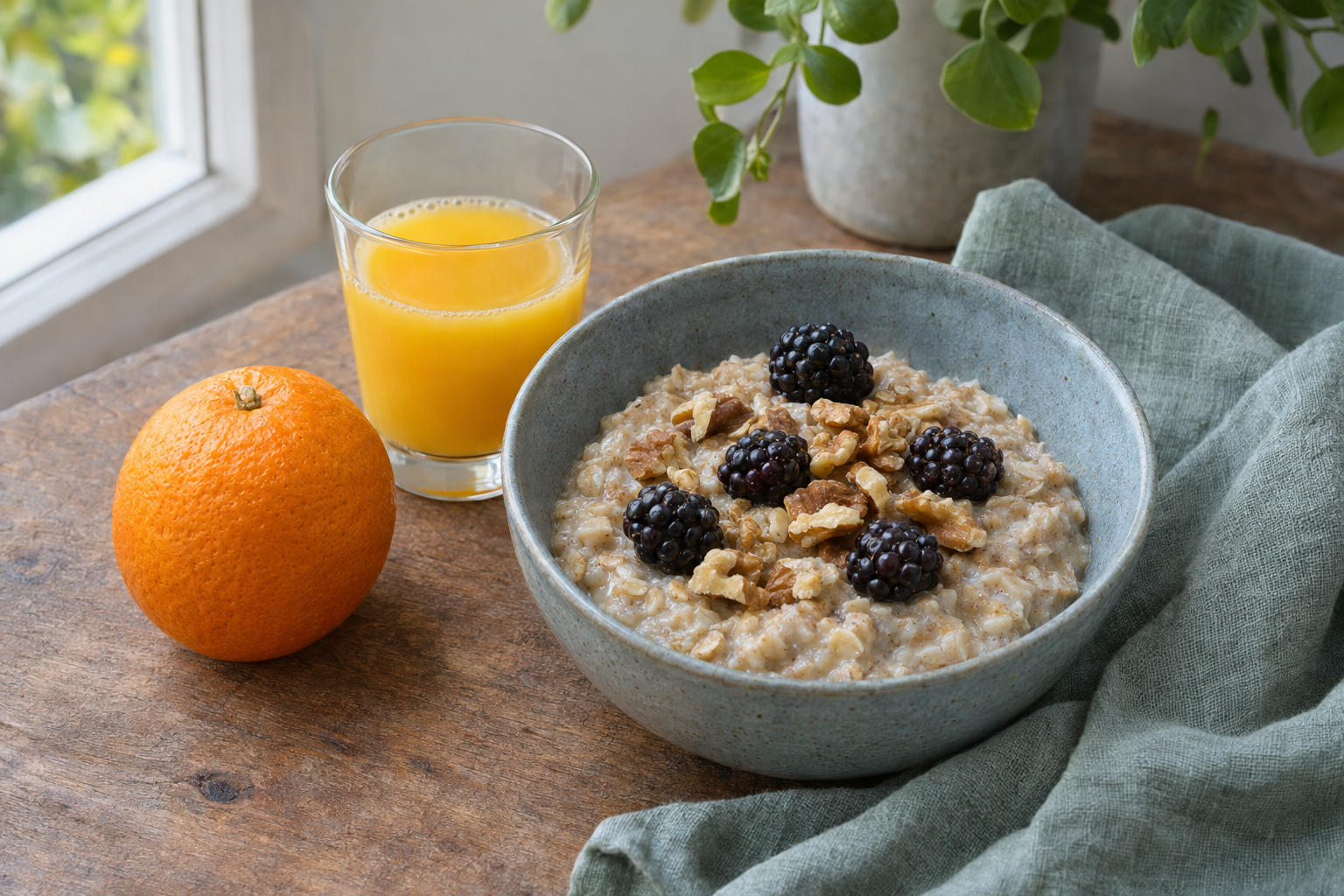
On the orange juice in the fridge, the label reads "100% fruit." That claim is accurate. There is nothing in the bottle but orange juice, and no sugar has been added. If you pour a glass alongside your toast and jam in the morning, you have every reason to feel well nourished. So why are you hungry again by half past ten?
The answer is not on the label, because the label only describes what is in the bottle. How quickly that content reaches your bloodstream is something it does not tell you. Yet that is precisely what determines how long your breakfast keeps you going. The orange in the glass is a different thing from the orange in your hand, even though the sugar is the same. What it lost during pressing was its fibre and its structure. That sounds like a minor detail, but your body notices the difference all the way to lunchtime.
AT A GLANCE: Orange juice contains almost as much sugar as a whole orange, but only around a tenth of its fibre. In human trials, the body released more insulin after the juice. Blood sugar dropped lower afterwards, and appetite returned sooner than after the whole fruit. A slowly digested breakfast keeps you fuller for longer and even dampens the blood sugar rise after lunch. In one trial with 7 volunteers, that rise was 38% lower when participants had eaten lentils rather than wholegrain bread four hours earlier (Jenkins et al., 1982). As of November 2026.
What Happens to an Orange When You Squeeze It?
The sweet juice inside an orange doesn't float around freely. It sits in countless tiny juice sacs, each one surrounded by membranes and cell walls. This packaging is made up of fibres, the same ones you find listed on a label as dietary fibre. When you eat an orange, your teeth and stomach have to break through all of that before the sugar is released. A juicer does the same job in a matter of seconds and leaves the packaging behind in the strainer.
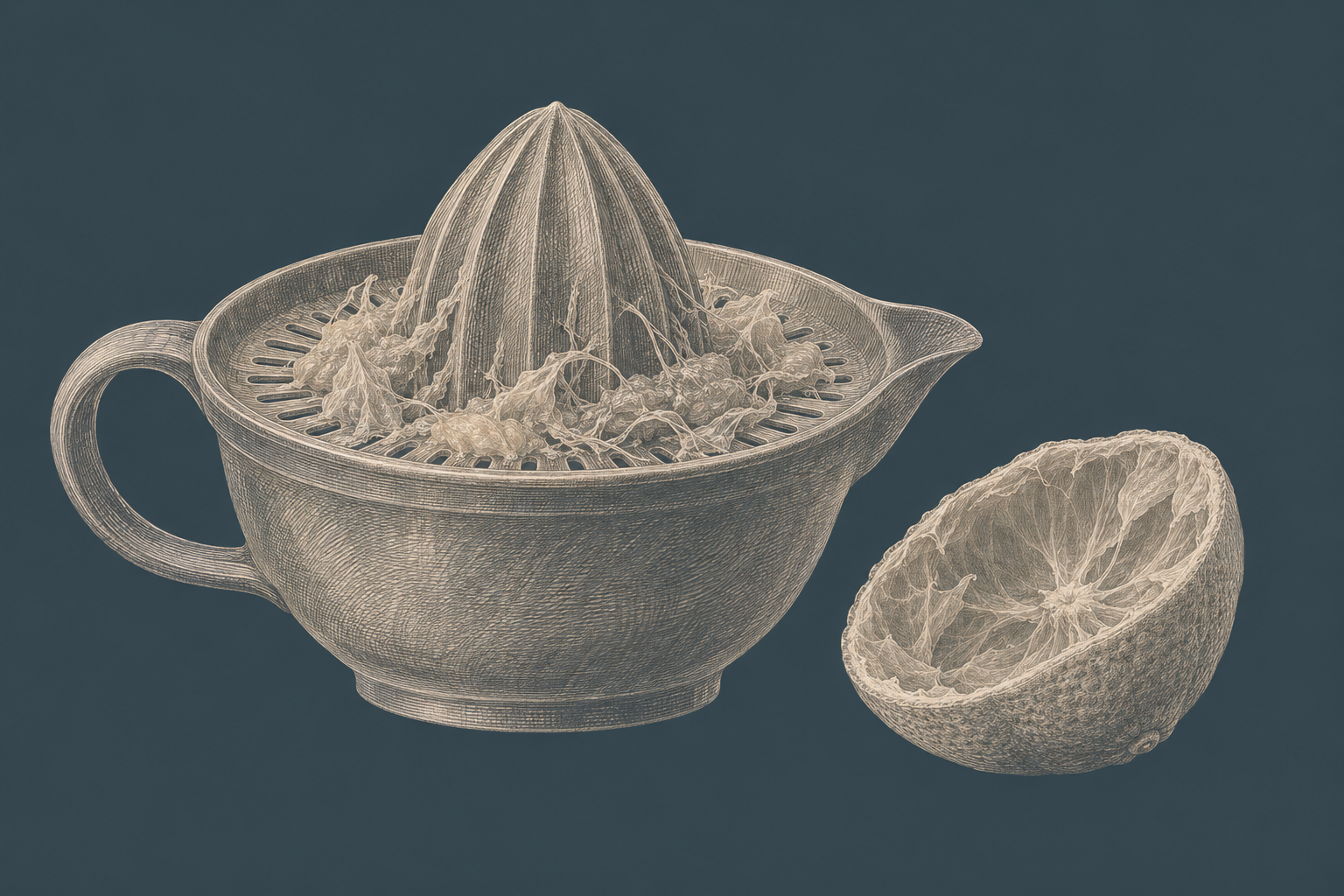
What stays in the strainer is missing from the glass. Along with the fibres, the orange loses the vast majority of its dietary fibre.
100 grams of orange contain 2.4 grams of dietary fibre; 100 grams of orange juice contain just 0.2 grams, while the sugar content stays almost the same (9.4 grams in the fruit, 8.4 grams in the juice) (USDA FoodData Central, entries 169097 and 169098). Does pressing the fruit actually change the sugar itself? As a chemist, I can tell you with confidence that nothing happens to the sugar molecules in the process. The same sucrose, the same Glucose and the same Fructose that were in the fruit are still there in the glass. What has changed is only the structure they were packaged in.
You already know from a campfire just how much structure matters. A log and a stack of newspaper are made up largely of the same substance, Cellulose. And yet the log burns for half an evening, while the newspaper flares up and is gone in moments. The orange and its juice work in much the same way.

Wood and paper are both largely made of Cellulose. How long they burn comes down to their structure.
Then there is the question of speed. A glass containing just over a quarter of a litre of orange juice holds the sugar of roughly two oranges (Papandreou et al., 2019). How long do you sit with two oranges, and how quickly is the glass empty? Someone actually timed this with apples back in 1977. Apple juice was consumed eleven times faster than whole apples were eaten (Haber et al., 1977).
That difference continues in the stomach. Researchers at the University of Nottingham used an MRI scanner to look inside the stomachs of 18 adults after they had eaten whole apples, apple sauce or apple juice. After whole apples, it took 65 minutes for the stomach to be half empty; after apple juice, just 38 minutes (Krishnasamy et al., 2020). What I find particularly telling is the apple sauce result. It still contains the fibres, just broken down, and yet the stomach emptied almost as quickly as with juice, in 41 minutes. So the fibres alone don't account for the difference. They need to be sitting where the fruit originally placed them. That fits with a finding from a study of 58 adults, in which apple juice with fibres added back in afterwards was no more filling than apple juice without fibres (Flood-Obbagy and Rolls, 2009). Both studies come from apple research, though. A comparable study using oranges is not something I'm aware of.
Why Does Hunger Come Back So Quickly After Juice?
What leaves the stomach quickly also reaches the blood quickly. The body responds with insulin, the hormone that moves sugar from the blood into the cells. The more sugar arrives at once, the stronger that response.
What this looks like with oranges was measured by a research group in 1981. Healthy volunteers received either whole oranges or orange juice, each containing the same amount of sugar. After the orange juice, their bodies released measurably more insulin. Their blood sugar then dropped lower than it did after the whole fruit. After the whole fruit, participants also felt fuller, and their appetite returned later (Bolton et al., 1981).
What actually drives this had been observed by the same group four years earlier, using apples. Blood sugar rose to a similar level after apples, applesauce and apple juice. The curves only diverged afterwards. After the apple juice, blood sugar dropped noticeably, while that drop was absent after the whole apples (Haber et al., 1977). What makes the difference, then, is the valley behind the peak. The test portions were large at 60 grams of carbohydrates, though, more than twice what a glass of orange juice contains.
And what does that valley have to do with your hunger? In a 2021 study, 1,070 people in the UK and the US wore a continuous glucose monitor and ate standardised breakfasts. The deeper their blood sugar dropped below baseline two to three hours later, the hungrier they were and the sooner they ate again (Wyatt et al., 2021). Do the maths. Someone who has breakfast at half past seven lands two to three hours later right around ten o'clock. The association was weak, however, and for hunger it was only statistically robust in the larger British group. Several of the authors also work for or advise the company Zoe.
A more recent study on oranges did not replicate the 1981 finding. In Abu Dhabi, 20 young women received two whole oranges, fresh orange juice and a sweetened orange nectar on separate days, each containing nearly the same amount of sugar. Over two hours, neither their blood sugar nor their insulin differed in any statistically reliable way (Papandreou et al., 2019). For insulin, the difference only narrowly missed statistical significance. The authors themselves consider their group potentially too small. They also measured for only two hours, so what blood sugar did afterwards remains unknown. A US study from 2021, on the other hand, did find the difference again: in the larger of its two groups, with 45 adults, blood sugar rose less overall after the whole orange than after the juice (Guzman et al., 2021). PepsiCo employees were involved in that one.
So how solid is all of this? For questions like this, I use a confidence rating on this site. Green means there are robust human measurements behind a claim. That whole fruit keeps you fuller for longer than its juice therefore gets a green rating, because research groups in Pennsylvania and Nottingham have measured exactly that, following on from the two early studies. I also keep the 1981 orange study on green. In my assessment, the Abu Dhabi study stopped measuring too early to overturn it. Yellow is for everything that is plausible but has not yet been directly demonstrated. That includes the idea that your hunger at ten in the morning comes specifically from this blood sugar dip. That is my read of the evidence. At an ordinary breakfast with a glass of orange juice, it has not yet been measured directly. Red stays for pure hypothesis, and this article does not call for one.
Does Breakfast Really Keep Hunger at Bay Until Lunch?
The mid-morning hunger is only half the story. The other half shows up at lunchtime.
In 1982, 7 healthy volunteers were given either lentils or wholegrain bread for breakfast, both containing the same amount of carbohydrates. Four hours later, everyone sat down to the same lunch. After the lentil breakfast, the blood sugar rise at midday was 38% lower (Jenkins et al., 1982). The plate at lunch was identical. The body handled it differently all the same. In the scientific literature, this phenomenon is called the second meal effect.
Interestingly, the same study found that simply eating less bread made no difference. After a bread breakfast containing only a quarter of the carbohydrates, blood sugar at lunch actually rose to 168% of the comparison value. What does that mean for you? The way I read it, breakfast is less about quantity and more about how slowly it is digested.
With 7 volunteers, this was a small study. What matters to me is that research groups in Sweden, Japan and China have since found the same effect with entirely different foods: whole barley and rye kernels (Nilsson et al., 2008), a slowly digestible liquid meal (Arai et al., 2007), and freshly cooked millet (Peng et al., 2024). That is why this finding sits firmly in the green for me.
The second meal effect does not show up with every breakfast that carries a healthy reputation, though. An earlier study from Lund in Sweden found that only two of four slowly digestible breakfasts produced the effect (Liljeberg et al., 1999). Why? That has not been settled. Some researchers suspect that gut bacteria ferment the fibres, and the compounds produced in the process make insulin's job easier (Brighenti et al., 2006), while the Swedish group found no evidence for that in their own data. The effect itself is well documented; the explanation behind it is still at amber. Worth noting: all of these studies measured blood sugar and insulin. Whether we actually feel more alert in the afternoon was a question nobody thought to ask.
What Does "100% Fruit" on the Label Actually Tell You, and What Doesn't It?
In the EU, only juice pressed directly from fruit may legally be called fruit juice. When it comes to juice from concentrate, the only thing added back is the water that was removed in the first place. Adding sugar to fruit juice has been prohibited since a 2012 directive (Directive 2012/12/EU). So what does the front of the pack actually tell you? "100% Fruit" simply restates what the words "fruit juice" already mean.
Fruit nectar is a different story. It may be diluted with water and sweetened with sugar or honey, up to a fifth of its total weight. For orange nectar, a fruit content of 50% is enough to qualify. Since June 2026, a further directive also allows manufacturers to print the phrase "fruit juices contain only naturally occurring sugars" alongside the words fruit juice (Directive (EU) 2024/1438). That statement is also true.
All of these claims describe where the contents of the bottle come from. How much sugar you're actually drinking is a different question, and the answer is on the back, in the nutrition table. Look at the row marked "of which sugars." A 250 ml glass of orange juice comes in at around 20 grams. What the front label won't tell you is how much fibre was left behind in the press, or what your blood sugar is doing two hours later.
That said, orange juice is not the same as sugar water. A Spanish study from 2026 found that the blood sugar peak in healthy young men was lower after pure orange juice than after an equally sweet drink containing no fruit at all, even though the overall rise across two hours did not differ significantly (García-Conesa et al., 2026). My reading of that: orange juice sits somewhere between sugar water and whole fruit. If you want to understand how to read the front and back of a food label more generally (and what "no added sugar" actually means in legal terms), take a look at my article on reading ingredient lists.
What can go on your plate in the morning?
I'm not going to tell you to give up your orange juice or your jam. The way I see it, jam on toast and a croissant work much the same way as juice does, but that doesn't mean they have to disappear from the breakfast table. I'd just make sure there's something alongside them that gives your body a bit more work to do.
- Eat the fruit instead of drinking it. You get the same sugar, plus the fibre, the chewing, and a stomach that stays full longer. Whether that fruit should be an orange depends, according to blood type nutrition, on your blood type. More on that in a moment.
- Make yourself a bowl of porridge. In a study with 48 adults, oats prepared with boiling water kept people fuller for longer than the same number of calories from ready-made oat cereal. At lunch four hours later, participants ate less after the porridge (Rebello et al., 2016). The study was funded by oat manufacturer Quaker and its parent company PepsiCo, with additional support from public research grants. That doesn't invalidate the findings. Someone has to fund this kind of research. I keep my eyes open when those connections exist, though. Nuts and berries on the side are something I'd genuinely recommend.
- Add an egg. In one study, 21 men ate either an egg breakfast or a bagel breakfast on separate occasions, both with the same number of calories. After the egg breakfast, they were less hungry three hours later and ate less at a lunch buffet (Ratliff et al., 2010). An egg with a little veg takes ten minutes.
- Give lentils a try. The second-meal effect was first measured with lentils back in 1982. They're not a typical breakfast food here, but leftover lentil salad from the night before does exactly the same job. If you have blood type B, blood type nutrition suggests leaving them out.
- Drink your juice with a meal and from a small glass. In a German study, 26 healthy adults drank a large amount of orange juice over four weeks (roughly a fifth of their daily energy intake), either with meals or between them. Drunk between meals, their body fat increased by an average of one kilogram. Drunk with meals, it did not (Hägele et al., 2018).
You may have noticed that yoghurt and quark don't appear anywhere in my examples. There's a personal reason for that. Since a serious gut illness in September 2023, I've been eating according to my blood type, and it suits me very well. For me, with blood type A, that means avoiding dairy and red meat, among other things. Oranges also fall into the category that blood type A is better off avoiding, and I genuinely can't tolerate them at all. The same applies to blood types 0 and AB, while for B the orange sits on the neutral list. For A and AB, grapefruit is on the green list instead. Blood type nutrition has a scientific basis, even if there are fewer studies on it than on blood sugar. That's largely because almost no one funds that kind of research. I advocate for it partly from personal experience as well. What fits your blood type under this approach (including at breakfast) is covered in my blood type courses.
If there's just one meal you want to change, I'd start with breakfast. Try it for a week. Keep the juice on the table if you like, but add a whole piece of fruit that agrees with you and something more filling alongside it. Then pay attention to how you feel at half past ten.
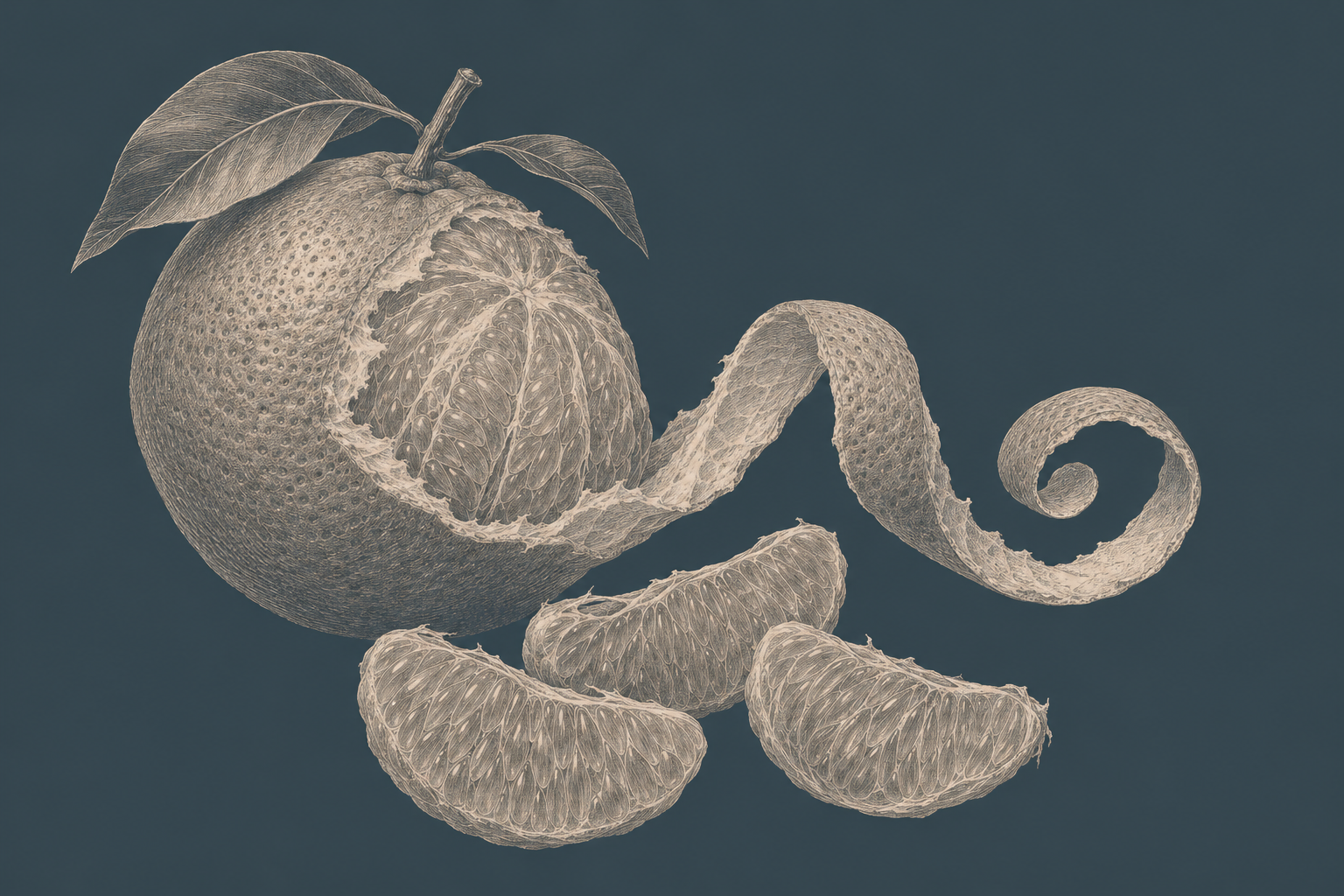
The whole orange delivers the same sugar as its juice and brings its fibre along with it.
My blood type courses. My wife Christine and I have developed a dedicated course for each of the four blood types: A, B, AB and 0. You'll learn where your blood type comes from and how your metabolism works according to the concept developed by Dr. Peter D'Adamo. You'll also get a traffic-light food list and a meal plan for breakfast, lunch and dinner, put together with the European supermarket in mind. After about an hour, you'll know what belongs on your plate. The courses give you a practical framework for everyday life and are not a substitute for medical advice. You'll find all four at thalyra.com/blutgruppen.
FAQ
Is freshly squeezed orange juice better than store-bought? I'm not aware of a direct comparison between the two. Either way, the fibres stay behind in the sieve when you press juice at home. The study from Abu Dhabi used fresh orange juice, and it contained as much sugar as two whole oranges (Papandreou et al., 2019).
Does orange juice with pulp help? A little. When researchers added 5 grams of fibre from the pressing residue back into orange juice, the blood sugar spike came out lower, roughly on par with eating a whole orange. The total blood sugar area over two hours didn't change in any statistically meaningful way (Guzman et al., 2021). PepsiCo employees were involved in that study. How much fibre a commercially sold "juice with pulp" actually contains, I haven't checked.
How much sugar is in a glass of orange juice? 100 grams of orange juice contains 8.4 grams of sugar. In a 250 ml glass, that works out to around 21 grams (USDA FoodData Central, entry 169098). The fresh juice used in the Abu Dhabi trial came in slightly higher, at 27 grams per 265 millilitres. None of that sugar is added. It comes from the fruit itself.
Is a smoothie better than juice? A smoothie still contains the fibres, though they've been broken down. In the Pennsylvania study, apple sauce landed somewhere between apple juice and a whole apple when it came to satiety (Flood-Obbagy and Rolls, 2009). In Nottingham, it left the stomach almost as quickly as juice did (Krishnasamy et al., 2020). For that reason, I'd treat a smoothie more like a juice than like whole fruit. I haven't looked at smoothies directly for this article.
What is the second meal effect? That's the term for the observation that one meal influences how the body processes the next. After a slowly digested breakfast, blood sugar rises more gradually after lunch as well. This was first shown in 1982 using lentils, and has since been demonstrated with barley, rye, and millet, among others.
Do I have to give up orange juice? No. I'd treat it as something to enjoy rather than as a serving of fruit. Drink it with a meal, keep the glass small, and make sure there's something on your plate that digests slowly.
References
- Jenkins DJ, Wolever TM, Taylor RH, Griffiths C, Krzeminska K, Lawrie JA, et al. Slow release dietary carbohydrate improves second meal tolerance. Am J Clin Nutr. 1982;35(6):1339–46. PubMed 6282105
- USDA FoodData Central (fdc.nal.usda.gov)
- Papandreou D, Magriplis E, Abboud M, Taha Z, Karavolia E, Karavolias C, et al. Consumption of Raw Orange, 100% Fresh Orange Juice, and Nectar- Sweetened Orange Juice-Effects on Blood Glucose and Insulin Levels on Healthy Subjects. Nutrients. 2019;11(9). PubMed 31509979
- Haber GB, Heaton KW, Murphy D, Burroughs LF. Depletion and disruption of dietary fibre. Effects on satiety, plasma-glucose, and serum-insulin. Lancet. 1977;2(8040):679–82. PubMed 71495
- Krishnasamy S, Lomer MCE, Marciani L, Hoad CL, Pritchard SE, Paul J, et al. Processing Apples to Puree or Juice Speeds Gastric Emptying and Reduces Postprandial Intestinal Volumes and Satiety in Healthy Adults. J Nutr. 2020;150(11):2890–2899. PubMed 32805050
- Flood-Obbagy JE, Rolls BJ. The effect of fruit in different forms on energy intake and satiety at a meal. Appetite. 2009;52(2):416–22. PubMed 19110020
- Bolton RP, Heaton KW, Burroughs LF. The role of dietary fiber in satiety, glucose, and insulin: studies with fruit and fruit juice. Am J Clin Nutr. 1981;34(2):211–7. PubMed 6259919
- Wyatt P, Berry SE, Finlayson G, O'Driscoll R, Hadjigeorgiou G, Drew DA, et al. Postprandial glycaemic dips predict appetite and energy intake in healthy individuals. Nat Metab. 2021;3(4):523–529. PubMed 33846643
- Guzman G, Xiao D, Liska D, Mah E, Sanoshy K, Mantilla L, et al. Addition of Orange Pomace Attenuates the Acute Glycemic Response to Orange Juice in Healthy Adults. J Nutr. 2021;151(6):1436–1442. PubMed 33704466
- Nilsson AC, Ostman EM, Granfeldt Y, Björck IM. Effect of cereal test breakfasts differing in glycemic index and content of indigestible carbohydrates on daylong glucose tolerance in healthy subjects. Am J Clin Nutr. 2008;87(3):645–54. PubMed 18326603
- Arai H, Mizuno A, Sakuma M, Fukaya M, Matsuo K, Muto K, et al. Effects of a palatinose-based liquid diet (Inslow) on glycemic control and the second-meal effect in healthy men. Metabolism. 2007;56(1):115–21. PubMed 17161233
- Peng X, Fan Z, Wei J, Liu R, Lou X, Hu J, et al. Fresh-Cooked but Not Cold-Stored Millet Exhibited Remarkable Second Meal Effect Independent of Resistant Starch: A Randomized Crossover Trial. Nutrients. 2024;16(23). PubMed 39683424
- Liljeberg HG, Akerberg AK, Björck IM. Effect of the glycemic index and content of indigestible carbohydrates of cereal-based breakfast meals on glucose tolerance at lunch in healthy subjects. Am J Clin Nutr. 1999;69(4):647–55. PubMed 10197565
- Brighenti F, Benini L, Del Rio D, Casiraghi C, Pellegrini N, Scazzina F, et al. Colonic fermentation of indigestible carbohydrates contributes to the second-meal effect. Am J Clin Nutr. 2006;83(4):817–22. PubMed 16600933
- Directive 2012/12/EU (eur-lex.europa.eu)
- Directive (EU) 2024/1438 (eur-lex.europa.eu)
- García-Conesa MT, García-Villalba R, Frutos-Lisón MD, García CJ, Marhuenda J, Zafrilla P, et al. Impact of the orange juice fruit matrix on postprandial glycemia: a crossover randomized trial in healthy young men with post hoc analysis of interindividual response variability. Food Funct. 2026;17(5):2292–2310. PubMed 41685398
- Rebello CJ, Johnson WD, Martin CK, Han H, Chu YF, Bordenave N, et al. Instant Oatmeal Increases Satiety and Reduces Energy Intake Compared to a Ready-to-Eat Oat-Based Breakfast Cereal: A Randomized Crossover Trial. J Am Coll Nutr. 2016;35(1):41–9. PubMed 26273900
- Ratliff J, Leite JO, de Ogburn R, Puglisi MJ, VanHeest J, Fernandez ML. Consuming eggs for breakfast influences plasma glucose and ghrelin, while reducing energy intake during the next 24 hours in adult men. Nutr Res. 2010;30(2):96–103. PubMed 20226994
- Hägele FA, Büsing F, Nas A, Aschoff J, Gnädinger L, Schweiggert R, et al. High orange juice consumption with or in-between three meals a day differently affects energy balance in healthy subjects. Nutr Diabetes. 2018;8(1):19. PubMed 29695707
Dr Holger Scheib is a chemist and Honorary Associate Professor at the University of Queensland. As “The HealthChemist” he translates research on ingredients and nutrition into plain language. More about me
Shall I send you the next article?
I write irregularly but thoroughly: new articles, honestly sorted into proven, plausible and hypothesis. No spam, no sales funnel.
Last updated: 16 November 2026