Nutrition
Green tea and blood sugar: an honest finding
In the lab, flavonoids inhibit the enzyme that splits starch. I co-authored the paper myself. And I still don't say: proven. What the human meta-analyses show, and what they don't.
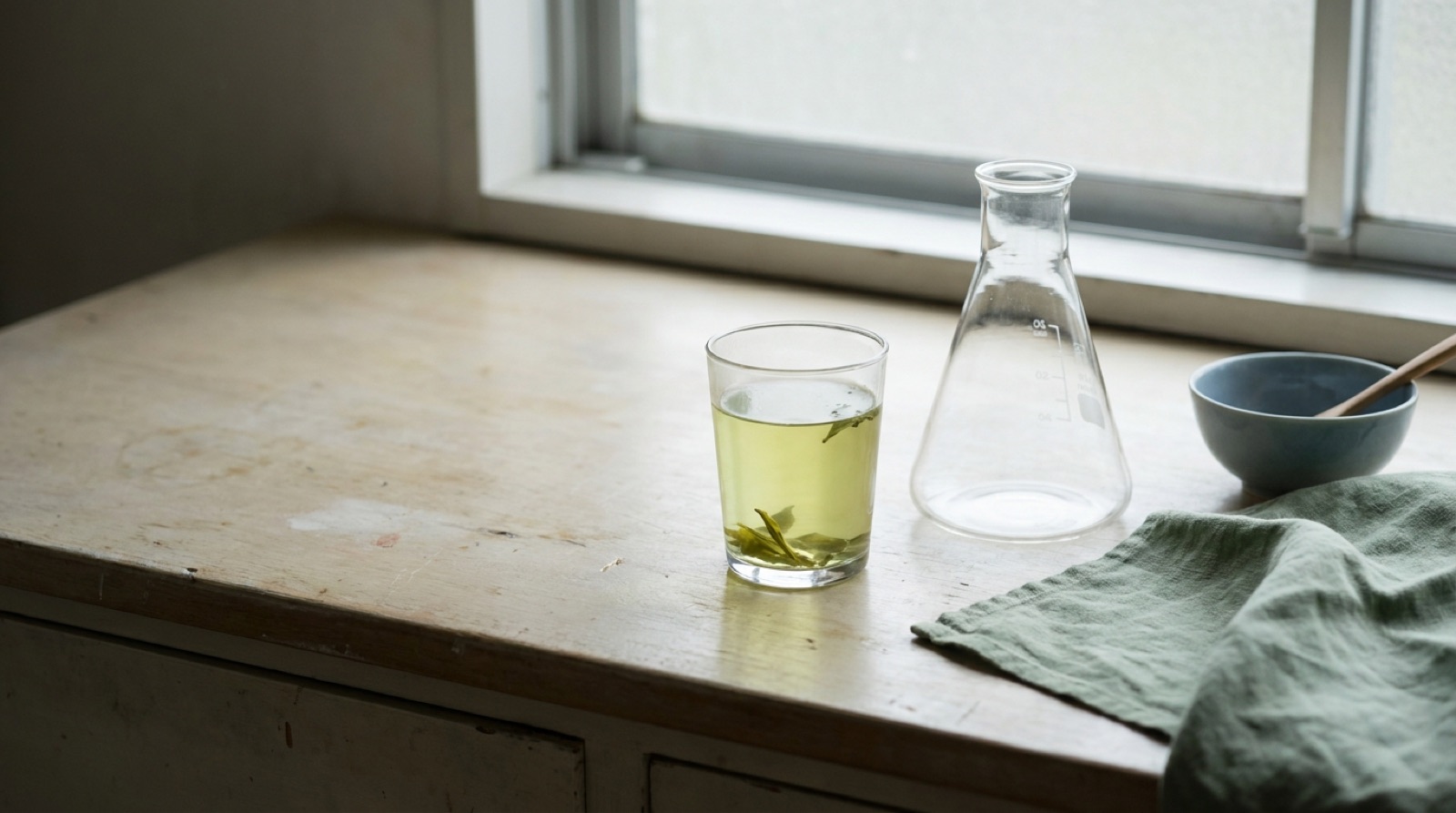
There is a sentence I could write, and it would not be a lie: plant compounds from green tea inhibit the enzyme that breaks starch down into sugar.
It is true. I co-authored the paper that showed it.
And it would still be misleading.
What we found
In 2008, in the Journal of Medicinal Chemistry, we examined which flavonoids inhibit human α-amylase. That enzyme breaks starch down in the mouth and the small intestine so the body can absorb it as sugar. Slow the enzyme down and you theoretically slow sugar uptake.
Of nineteen flavonoids tested, seven inhibited the enzyme at a concentration below 100 micromolar. Using a computer model, we could show which structure a molecule needs to do this: particular hydroxyl groups at particular positions that form hydrogen bonds in the enzyme's active site.
The mechanism is clean, traceable and reproducible.
Lo Piparo E, Scheib H et al. J Med Chem. 2008;51(12):3555–3561. PMID 18507367.
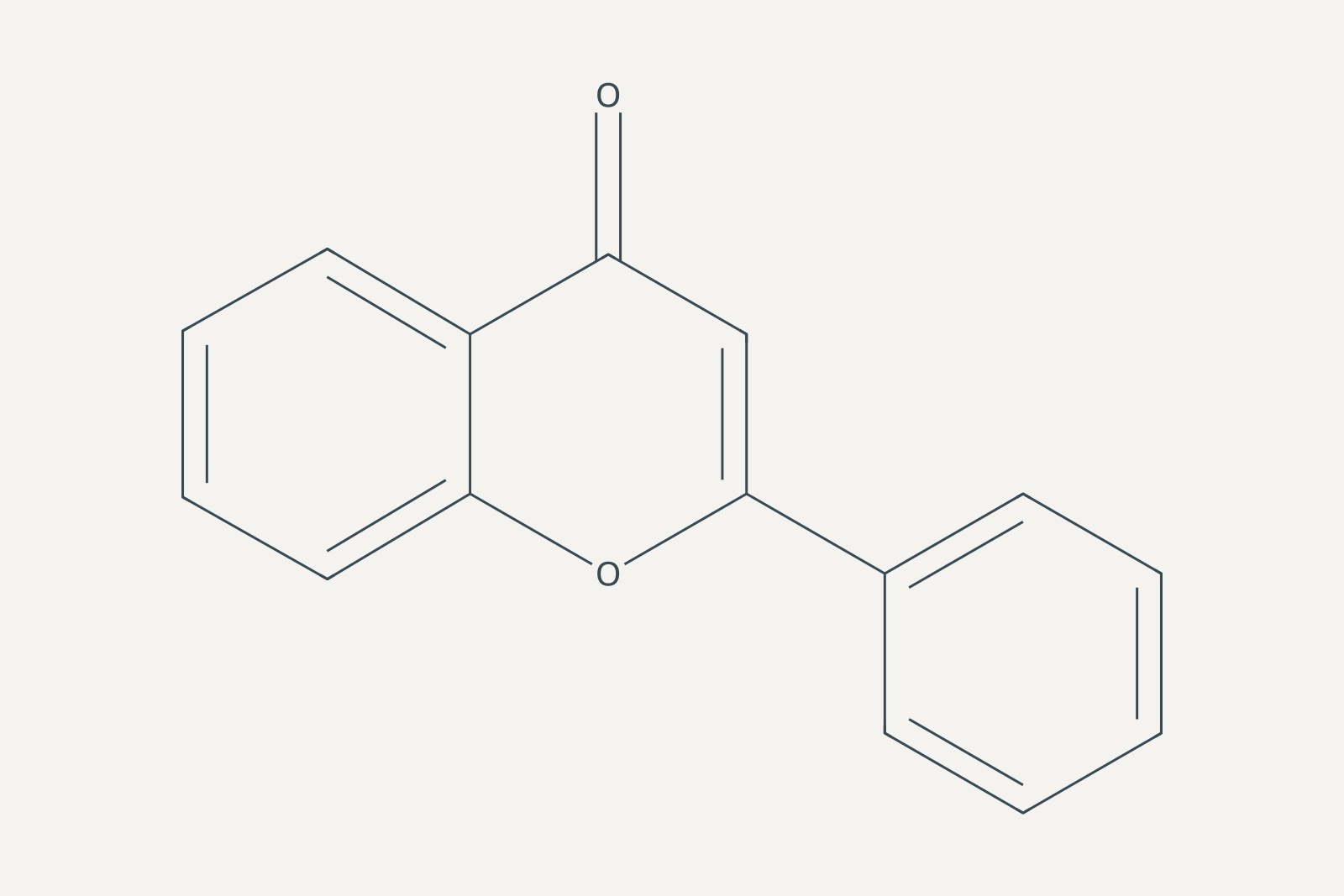 The core scaffold of all flavones. The hydroxyl groups attached to it decide the inhibitory effect.
And here comes the part rarely read in the summary: all of this happened in a test tube, at a defined concentration, on isolated enzyme.
The road from the test tube into a human
Between a Petri dish and a breakfast lie a few problems.
Drink a cup of green tea and the flavonoids do not reach the concentration we worked with. They are metabolised in the gut, part is lost, part is reshaped by gut bacteria. And the starch in your bread does not meet isolated enzyme but a digesting gut with transit times, a food matrix, and a body that actively regulates blood sugar.
Does the effect from the Petri dish reach a human at all? No structural formula decides that. Studies in humans do.
What the human studies show
They exist, and they are done properly.
A 2013 meta-analysis pooled 22 randomised controlled trials with 1,584 participants. Fasting blood sugar fell — by 1.48 milligrams per decilitre.
Zheng XX et al. Am J Clin Nutr. 2013;97(4):750–762. PMID 23426037.
A second meta-analysis from 2020, 27 studies, 2,194 participants, arrived at 1.44 milligrams per decilitre.
Xu R et al. Nutr Metab (Lond). 2020;17:56. PMID 32670385.
Two independent analyses, the same order of magnitude. That is a real signal. The effect exists.
So what does that mean in practice? A normal fasting blood sugar sits at about 80 to 100 milligrams per decilitre. The effect is therefore around one and a half percent, less than the variation between two measurements on consecutive days. It lies within what a breakfast, a bad night or an infection shifts in you.
And the value that really matters does not move: both meta-analyses found no effect on HbA1c, the long-term value that reflects average blood sugar over the past weeks. Insulin didn't change either.
Why this reads "plausible" and not "proven"
I have three labels into which I sort every statement.
Proven means: supported by solid human studies, with an effect on something that matters.
Plausible means: there is a clean mechanism, there is early human data. But proof that it changes anything in everyday life is missing.
Hypothesis means: a reasoned guess, nothing more.
"Green tea slows sugar absorption" is plausible. The mechanism is described, I helped describe it. The effect in humans is measurable. And it is so small that it decides nothing in everyday life.
It would be easy to let the sentence stand. It sounds good, it is defensible, and no one would correct me. That is exactly why I don't write it.
What this means in practice
Drink green tea if you enjoy it. It is a pleasant drink with very few calories, and the evidence gives no reason to avoid it.
Don't drink it because you believe it regulates your blood sugar. It doesn't, to any degree you would notice.
And be especially careful with high-dose green tea extracts in capsule form. There the evidence is different, and it is not more harmless but more unpleasant. That is the subject of a separate article.
The real point
A mechanism is not an effect. A lab finding is not everyday life. And a statistically significant effect is not automatically a meaningful one.
I could cite my own publication as evidence that green tea lowers blood sugar. A respected journal would sit beneath it and my name beside it.
It would still not be true enough.
Dr Holger Scheib is a chemist and Honorary Associate Professor at the University of Queensland. As “The HealthChemist” he translates research on ingredients and nutrition into plain language. More about me
Shall I send you the next article?
I write irregularly but thoroughly: new articles, honestly sorted into proven, plausible and hypothesis. No spam, no sales funnel.
Last updated: 22 August 2026