Myth & Evidence
Detox: what your liver really needs (in short: no tea)
There is not a single randomised human trial for commercial detox cures. What the liver actually does, why it needs no cleansing, and which detox product can demonstrably cause harm.
How do I detox my liver? Type that question into a search engine and you are offered teas, cleanses and powders before you get an answer. So let me begin with the part that is undisputed, because it stands in every biochemistry textbook.
Your body detoxifies continuously, right now, while you are reading this sentence.
How it actually works
Foreign substances (medicines, alcohol, plant compounds, breakdown products of your own metabolism) are processed by the liver in two phases.
In phase I, enzymes of the cytochrome P450 family attack the molecule and attach a reactive group to it. Usually the substance becomes more water-soluble, but sometimes more reactive than before.
In phase II, a large, water-soluble residue is coupled to that group: glucuronic acid, sulfate, glutathione. Now the molecule is nicely water-soluble and recognisable to transport proteins.
After that it is excreted, via the bile into the gut, or via the blood to the kidney, where it is filtered and flushed out with the urine. This system is finely regulated by nuclear receptors and adjusts its capacity to the load.
Eloranta JJ, Meier PJ, Kullak-Ublick GA. Methods Enzymol. 2005;400:511–530. PMID 16399367.
It is one of the most elegant systems I know in biochemistry. And it has an inconvenient property from a marketing point of view: it runs by itself. It needs no cure, no powder, no tea. It has no resting state you would have to wake it from.
The phrase "detox the liver" presupposes that it otherwise wouldn't. It does. Otherwise you would be dead.
What detox cures demonstrably deliver
Here it gets brief, and the brevity is the finding.
A critical review in the Journal of Human Nutrition and Dietetics went through the available literature on commercial detox diets. Result: there is very little clinical evidence to support their use. The few studies are methodologically flawed and have small sample sizes. And then the sentence that counts: no randomised controlled trials have been conducted to assess the effectiveness of commercial detox diets in humans.
Klein AV, Kiat H. J Hum Nutr Diet. 2015;28(6):675–686. PMID 25522674.
Not a single one, not even a bad one or a small one.
That is not proof they don't work. Absence of evidence is not evidence of absence. But it reverses the burden of proof. Anyone selling a product meant to remove toxins must show which toxin, by how much, and how they measured it. I have found these details on no package.
Usually the first word is already missing: which poison.
Where real harm is documented
And now the twist that interests me most as a chemist. For while the benefit is unproven, harm is well documented for one of the most popular "detox" products of all.
High-dose green tea extract can damage the liver.
The United States Pharmacopeia commission systematically evaluated the literature: case reports link liver damage to an intake of roughly 140 to 1,000 milligrams of EGCG per day. EGCG is the main catechin of green tea. Taking it on an empty stomach increases absorption into the blood. Susceptibility varies between individuals and is partly genetic. The Pharmacopeia consequently added a warning to its monograph.
Oketch-Rabah HA et al. Toxicol Rep. 2020;7:386–402. PMID 32140423.
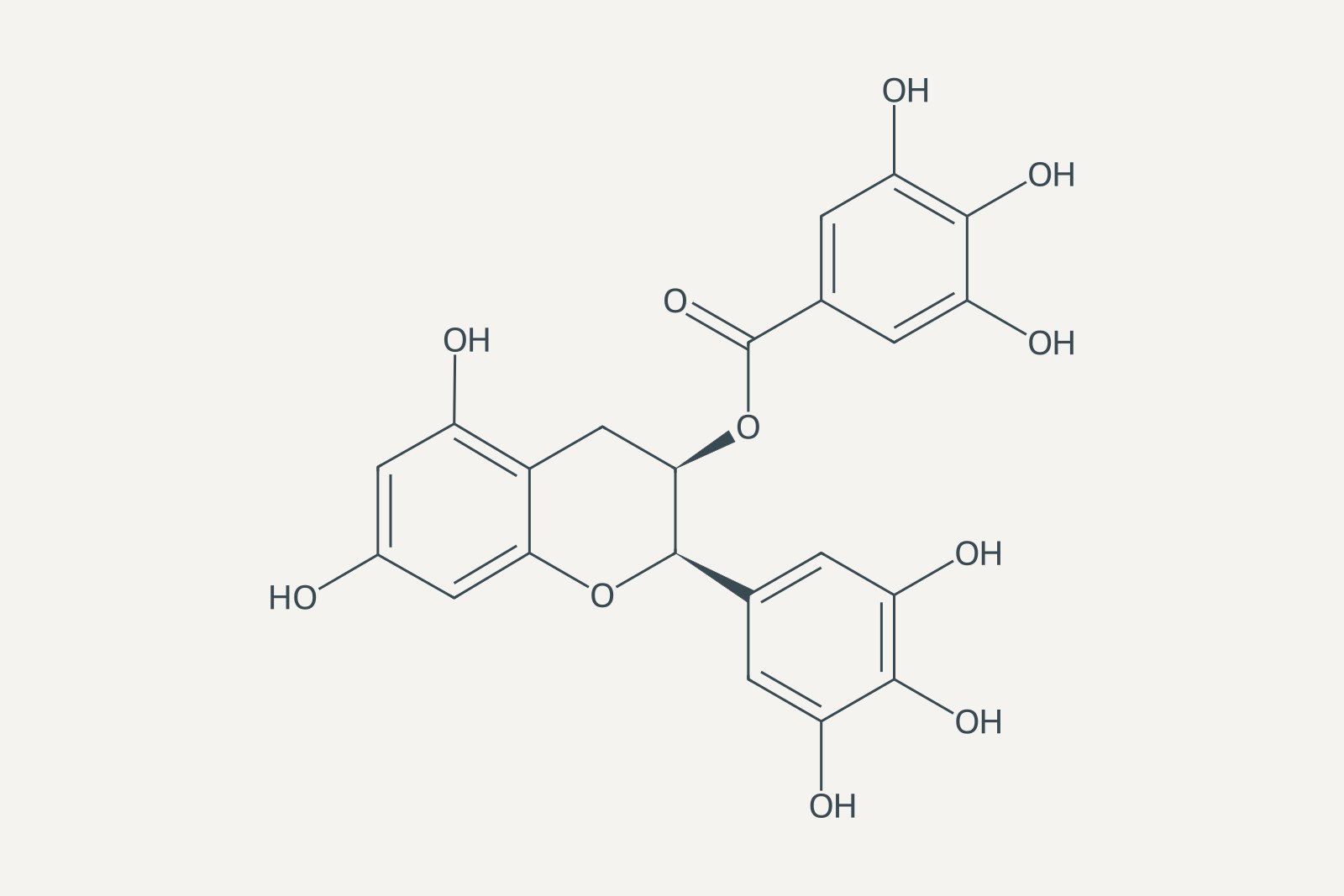 EGCG, the main catechin of green tea. Harmless in the cup, a different story as a high-dose extract.
It did not remain a collection of case reports. In an analysis of a randomised trial with over a thousand participants (843 milligrams of EGCG daily for twelve months) liver values rose measurably, depending on the genotype of the metabolising enzymes.
Acosta L et al. J Diet Suppl. 2023;20(6):850–869. PMID 36178169.
Let me put it as clearly as I can: a drink consumed for centuries is unproblematic. What it does for blood sugar I have sorted out in a separate article. Its concentrated extract in capsule form is something else. The dose makes the poison. That is the oldest sentence in toxicology, and it has not been refuted to this day.
It is a remarkable irony: some products meant to detox the liver burden it.
Why the story works anyway
Because it speaks to a real experience.
After a detox week, many people genuinely feel better. I believe that at once. It just almost never has to do with the advertised mechanism. Anyone who drinks no alcohol for a week, eats few processed foods, drinks more water and sleeps earlier feels better afterwards. They would have without the tea.
The tea takes the credit for the behaviour change. That is a good deal — for the tea.
What I say as a chemist
There are quite real situations in which detoxification is a genuine medical problem, heavy-metal poisoning or an overdose for instance. For them there are chelators, antidotes and dialysis, applied under medical supervision and with measured values before and after.
What separates these procedures from a detox tea is not conviction. It is measurement.
If someone promises to remove something from your body, ask them three things. What exactly? How much of it was in there? And how did you measure that it is now out?
To those three questions I have never received an answer.
What the liver really needs
Little alcohol, enough sleep, and a weight it doesn't fatten under. Beyond that our liver mostly wants to be left alone.
It has been doing its work since the day you were born. Without a subscription.
The note on liver damage refers to high-dose extracts in supplements, not to green tea as a drink. This article does not replace medical advice. If you take medication or have symptoms, speak with a doctor.
Dr Holger Scheib is a chemist and Honorary Associate Professor at the University of Queensland. As “The HealthChemist” he translates research on ingredients and nutrition into plain language. More about me
Shall I send you the next article?
I write irregularly but thoroughly: new articles, honestly sorted into proven, plausible and hypothesis. No spam, no sales funnel.
Last updated: 22 August 2026