Nutrition
Blood Type Diet: Why I Eat for My Blood Type as a Chemist
Your blood type is a sugar that also sits in your gut. What lectins have to do with it and why I have been eating according to my blood type since 2023.
How many nutrition books are sitting on your shelf right now? Low carb has its devoted followers, intermittent fasting does too, and so does plant-based eating. Every nutrition book that made it onto the bestseller lists has helped someone, and yet each of these schools explains with the same certainty why all the others have it wrong. Who are you supposed to believe when you've tried three of them and none of them fit your life for more than a few weeks?

Every one of these books has helped someone. The question is which one fits you.
I found my answer somewhere hardly anyone thinks to look: on my blood donor card. That's where your blood type is listed. Chemically speaking, it's a short sugar chain sitting on your red blood cells, and in most of us it also appears on the lining of the gut, right where your food actually arrives. I have blood type A and have been eating according to my blood type since September 2023. For me, it's the best starting point if you want to figure out which way of eating actually suits you.
AT A GLANCE: The blood type diet developed by Peter D'Adamo organises foods for blood types O, A, B and AB into well-tolerated, neutral and poorly tolerated. Its chemical basis is lectins. These are proteins from food that bind to sugar chains, and your blood type is one such sugar chain. What is established: certain plant lectins selectively recognise a specific blood type, the sugar chains of the blood type are also present in the gut, and they are linked there to the composition of the gut microbiome. In a study of 9,015 Dutch participants, the gut bacterium Faecalibacterium prausnitzii more frequently carried the genes for metabolising the A-sugar when its host secreted that sugar into the gut (Zhernakova et al., 2024). As of November 2026.
Why Do You React Differently to the Same Foods?
In 2015, the Weizmann Institute in Israel monitored the blood sugar of 800 people continuously for one week, across a total of 46,898 meals. Participants responded so differently to identical meals that the researchers concluded general dietary recommendations could only be of limited use (Zeevi et al., 2015). Five years later, a British study of 1,002 healthy adults confirmed the same picture. After identical test meals, the variation in blood fat levels between participants was 103%, and in blood sugar levels 68% (Berry et al., 2020).
We respond measurably differently to the same food. What does that mean for you? If keto or a low-fat week never stuck, that says more about the claim these programmes make to work for everyone than it does about your discipline. "Listen to your body" sounds reasonable enough, but it doesn't tell you where to start on a Monday morning. For that, you need a marker you can actually orient yourself by. Something easy to determine, stable across a lifetime, and connected to how you digest. Your blood type fits all of that.
What Does Your Blood Type Have to Do with What You Eat?
Around 1900, the Viennese physician Karl Landsteiner discovered that the blood of some people clumps together when mixed with the blood of others, and in doing so, he had found the blood groups (Yamamoto, 2000). What they are made of is covered in every textbook today. The difference is surprisingly small. All blood groups share the same basic structure of a few sugar building blocks, known in technical terms as the H antigen. In blood group A, an enzyme attaches an additional sugar to this basic structure (N-acetylgalactosamine), while in blood group B it is galactose, and people with blood group AB carry both variants. In blood group 0, this final building block is missing, leaving only the basic structure intact (Smolarek et al., 2008).
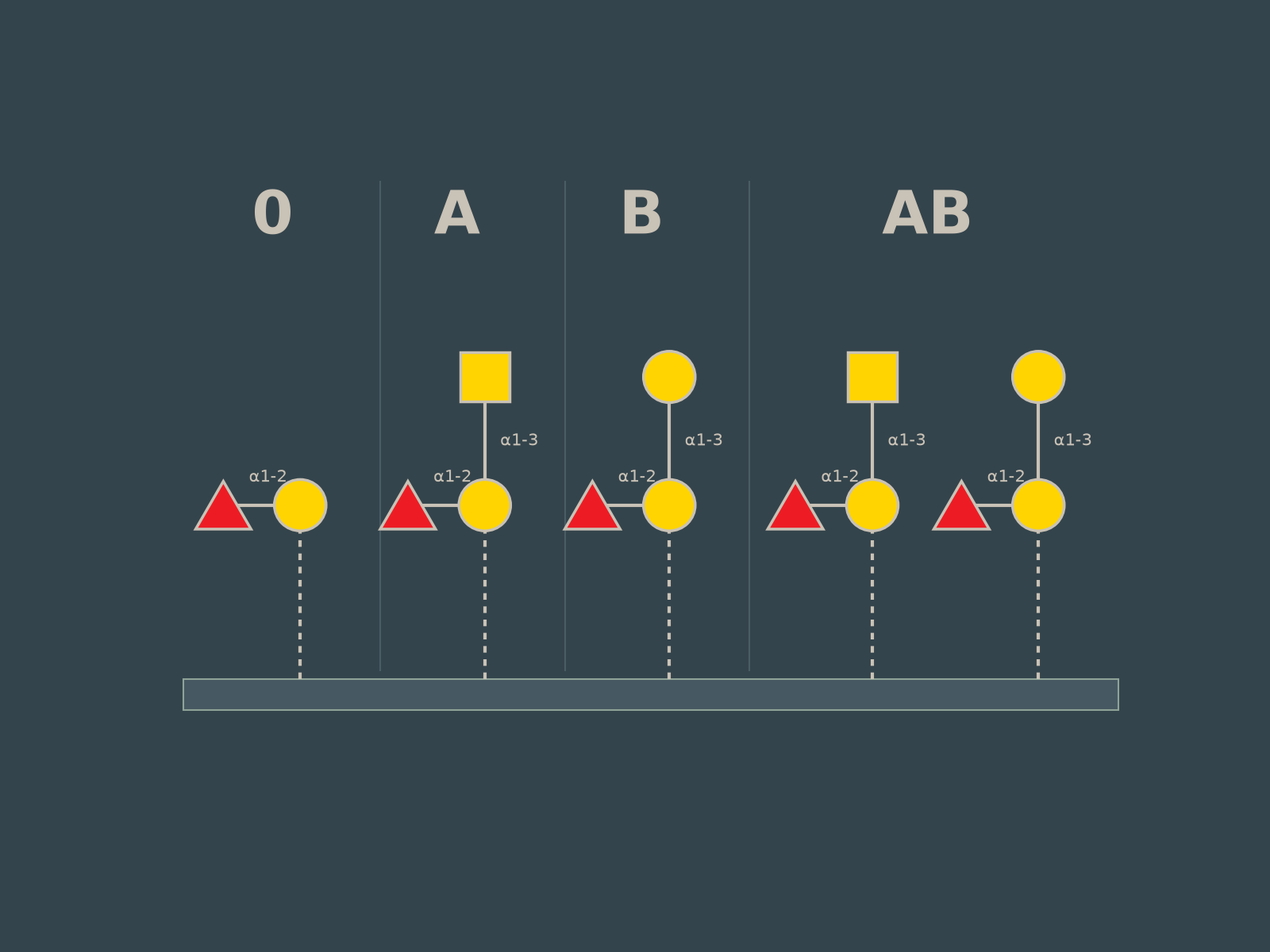
Figure: The sugar building blocks of blood groups 0, A, B and AB. All four share the same basic structure of galactose (yellow circle) and fucose (red triangle), the H antigen. In blood group A, N-acetylgalactosamine (yellow square) sits on top of this; in blood group B, a second galactose. Blood group AB carries both variants. In blood group 0, the basic structure remains without any addition. (Smolarek et al., 2008; Sikder et al., 1986)
What helps me here is the image of four keys cut from the same blank. The shaft and the bow are identical across all four. Only the last notch on the bit sets them apart.

Four blood groups, one blank. The difference lies in the last notch on the bit.
These sugar chains do not stay confined to the blood. In around 80% of us, the body also releases them into saliva and into the mucus lining the gut (Kelly et al., 1995; Wacklin et al., 2011). What you eat therefore meets your blood group as early as the gut. And some foods bring their own locks along, the very locks these keys fit. They are called lectins.
What are lectins, and how do they recognise your blood type?
Lectins are proteins that recognise sugars and bind to them. Plants are packed with them, especially seeds and tubers like grains, potatoes and beans (Freed, 1999). They were discovered over a hundred years ago because they cause red blood cells to clump together, much like foreign blood did in Landsteiner's experiments. It later emerged that many of them bind only to one very specific sugar structure (Sharon and Lis, 2004). Some can even distinguish between blood types. The lectin from the lima bean binds selectively to the marker of blood type A (Sikder et al., 1986), while a lectin from gorse recognises the H antigen, the underlying structure that sits exposed in blood type O (Gilboa-Garber et al., 2006). In blood transfusion laboratories, lectins were standard tools for decades before anyone took an interest in their role in nutrition (Freed, 1999). The idea that a bean produces a molecule capable of telling your blood type from mine has stayed with me ever since.
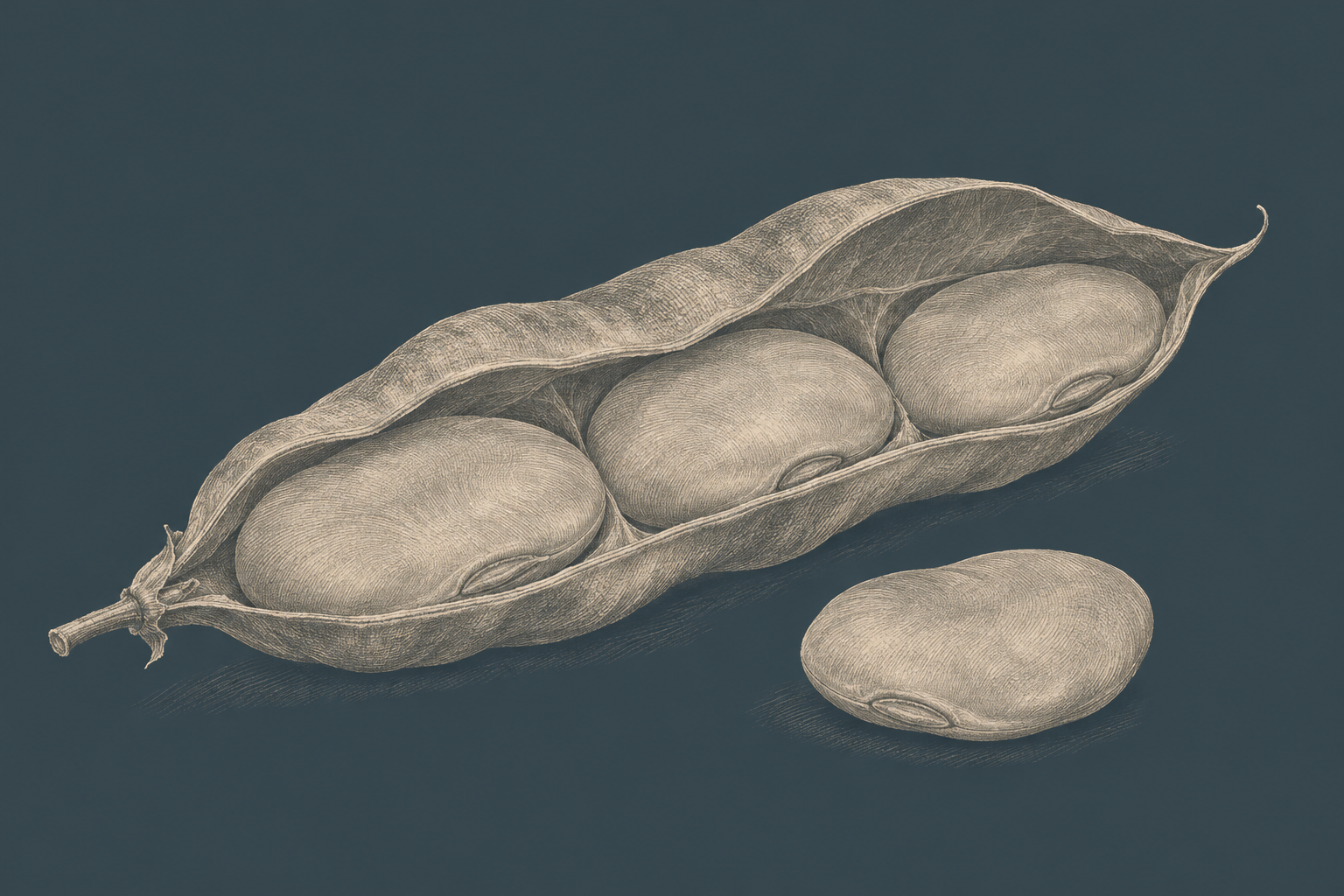
The lima bean produces a lectin that binds selectively to the sugar characteristic of blood type A.
How many lectins do we actually eat? More than most of us would guess. Of 88 everyday foods from the American diet, 29 showed measurable lectin activity, including salad ingredients, fresh fruit, roasted nuts and processed grain products (Nachbar and Oppenheim, 1980). Plant lectins survive digestion and bind to the sugar structures of the cells lining our gut (Vasconcelos and Oliveira, 2004). Just how severe that can get is illustrated by red kidney beans, which when eaten raw can trigger acute gastrointestinal inflammation, sometimes with serious consequences. The most likely culprit is their lectin, which thorough cooking destroys (Noah et al., 1980). What the cooking pot does to plant compounds like these, I covered in my article on antinutrients.
Why don't we all get sick, then, given that we all eat lectins? That was the question British allergist David Freed posed in the British Medical Journal in 1999. Part of his answer was that the sugar structures on our cells differ from person to person (Freed, 1999). The most familiar of these differences you already know, because it is printed on your blood donor card.
What Do Your Gut Bacteria Do with Your Blood Type's Sugar?
For the bacteria in your gut, these sugar chains serve as both anchor point and food source. That blood type is linked to specific gut bacteria of the genera Bacteroides and Faecalibacterium was shown in 2021 by an analysis of the genetic data of 8,956 Germans (Rühlemann et al., 2021). But why would a bacterium care about your blood type?
A 2024 Dutch study of 9,015 people offered one explanation. The gut bacterium Faecalibacterium prausnitzii more frequently carried the genes for metabolising N-acetylgalactosamine when its host secreted the blood type A sugar into the gut. In the lab, bacterial strains with these genes grew on N-acetylgalactosamine as their sole carbohydrate source, while strains without these genes did not (Zhernakova et al., 2024). Part of our gut microbiome can, it seems, metabolise precisely the sugar building block that defines blood type A. Remember the last notch on the key? In the test tube, that notch was enough to feed these bacteria.
Disease-causing pathogens also navigate by these sugar chains. The stomach bacterium Helicobacter pylori attaches to a sugar structure on the gastric mucosa that belongs to the blood group sugar family, and loses its grip on it as soon as that structure carries the additional building block of blood type A. The researchers concluded that people with blood type A or B likely offer it fewer docking sites than people with blood type 0 (Borén et al., 1993). Consistent with this, stomach and duodenal ulcers occurred most frequently in blood type 0 among more than one million Swedish and Danish blood donors (Edgren et al., 2010).
Your blood type, then, has a say in what happens in your digestive tract. An American naturopath built an entire nutritional philosophy on these very sugar chains.
What Did Peter D'Adamo Make of It?
His father James D'Adamo had already observed over years of practice that his patients responded very differently to the same dietary recommendations. His son turned those observations into a system, published in 1996 under the title "Eat Right 4 Your Type," which became an international bestseller. Peter D'Adamo connects the lectins found in food with the sugar chains that define each blood type. When a lectin encounters the sugar chain it matches, it binds to it and irritates the cells lining the gut. When there is no match, it passes through without effect. Each blood type therefore gets its own list of beneficial, neutral, and foods to avoid. The lima bean, with its A-lectin, appears on the avoid list for blood type A, as it happens.
- Blood type O, the hunter, eats a protein-rich diet with plenty of meat and fish, and avoids wheat, corn, and dairy.
- Blood type A, the cultivator, eats a plant-based diet centred on vegetables, legumes, fermented soy, and fish, and avoids red meat and dairy.
- Blood type B, the nomad, is the only group that can eat dairy freely, and avoids chicken, corn, and buckwheat.
- Blood type AB, the enigma, combines elements of the A and B plans, and avoids, among other things, chicken, corn, and buckwheat.
Four bullet points are not enough to navigate the supermarket, of course. If you want to know exactly what belongs on the green, yellow, and red list for your blood type, you will find it in the blood type courses that my wife Christine and I developed together. There is a video course of around one hour for each blood type, recorded in my own voice, covering the traffic-light lists for meat, fish, dairy, grains, vegetables, and fruit.
How Well Has Blood Type Eating Been Studied?
The building blocks are established. Blood types are sugar chains, certain lectins recognise them selectively, and in the digestive tract they serve as food for bacteria and as docking points for pathogens. That individual foods are therefore more or less well tolerated depending on blood type is the step D'Adamo derives from this. I consider it plausible.
On the diet itself, there is an analysis from Toronto. There, 1,455 young adults were surveyed by questionnaire about how closely their eating habits matched one of the four blood type plans. Those who ate similarly to what the plan for blood type A recommends had, on average, lower blood pressure, lower blood lipids, and less insulin in their blood, regardless of their own blood type (Wang et al., 2014). That a plant-forward diet low in red meat lowers blood pressure and blood lipids does not surprise me. In Toronto, however, nobody actually prescribed a blood type plan. The researchers calculated after the fact, from the questionnaires, who happened to eat in a similar way. How many participants genuinely followed one of the plans strictly was something they could not determine, by their own admission. Whether the same plan benefits someone with blood type A more than someone with blood type O is not something a questionnaire can answer, as far as I am concerned.
What you need for that is a study in which people of the same blood type eat either according to their blood type plan or as usual, and are then compared with one another. That is precisely the kind of comparative study the Belgian Red Cross called for back in 2013, after reviewing 1,415 references and finding not a single piece of work that had actually tested the health benefits of blood type eating (Cusack et al., 2013). I am not aware of such a study to this day. Why is that? It would need to run for months with a large number of participants and would be correspondingly expensive, yet you cannot patent a diet. Nobody earns enough from broccoli for blood type A to fund a study like that. The fact that few studies exist does not mean blood type eating does not work. It is scientifically grounded and simply not yet fully investigated. I follow what comes next with great interest.
Why I Eat According to My Blood Type
On the night of 10 to 11 September 2023, I was lying in hospital with blood in my stool, pain in my lower abdomen and a profound weakness. I had, quite literally, made my peace with dying. The diagnoses shifted between Crohn's disease, ulcerative colitis and leaky gut syndrome. In the end, it remained unclear what it had actually been. An antibiotic most likely saved my life. What followed was a two-month course of cortisone that I could not tolerate and eventually stopped, several colonoscopies, and the prospect that part of my intestine might need to be removed. Stopping a course of treatment, by the way, is something I would not recommend to anyone without first consulting their doctor.
What was left for me? When I asked whether I could do anything through diet to counter the inflammation, the answer I got was: "It can't hurt." After that, Christine and I took matters into our own hands and ate consistently according to our blood types. For me, with blood type A, that meant no more dairy and no more red meat, among other things. The change took effect quickly. And my body still lets me know the moment I get careless. If I slip for two days, I feel it immediately, in my gut, my skin, my fitness and my energy levels. As soon as I get back on track, I feel better just as quickly. Eating according to her blood type works equally well for Christine.
That is my experience. My diet did not replace the antibiotic. It came after. But in my late 50s, I feel healthier today than I did in my mid-30s.
How do you find out whether the blood type diet works for you?
You try it, and in a way that lets you reach a real verdict at the end.
- Find out your blood type. It's on your blood donor card. If you don't have one, your GP can add it to your next blood draw, or you can pick up a self-test kit from the pharmacy for a few pounds.
- Start with the main triggers on your list. For blood type A, those are red meat, cow's milk products, and nightshade vegetables like tomatoes, peppers, and potatoes. Every blood type has different ones. I'd suggest taking small steps, as they tend to stick longer than overhauling your entire kitchen on day one.
- Stick with it for four weeks. For me, two careless days are enough to set things back. For a verdict in the other direction, your body needs more time than that.
- Keep a food diary. Each evening, jot down briefly how your digestion, skin, sleep, and afternoon energy levels were. Without notes, memory plays tricks.
- Then test individual foods back in. Reintroduce one eliminated food for a few days and see what happens. What doesn't bother you can stay. And what does bother you, you'll now know by name.
I think of the lists as a guide for your everyday life. What actually counts is what your diary says after four weeks. If you have a medical condition or take medication, please talk things through with your doctor before making any changes, and don't stop anything on your own.
You don't need another book on the shelf for this experiment, because you're starting with something you've carried since birth, something that sits at the table with you in your gut every single day.
The blood type courses. Christine and I have developed a compact video course for each of the four blood types. I recorded all four myself. In around an hour, you'll learn the origin story of your blood type and get a straightforward explanation of your metabolic profile. That includes the traffic-light lists for meat, fish, dairy, grains, vegetables, and fruit, the main triggers for your blood type, and a meal framework for breakfast, lunch, and dinner that works in a standard European supermarket. You pay once and keep access permanently. The courses are available individually or as a bundle with all four (which makes sense if you still need to find out your blood type or want to compare within your family). You'll find the courses at thalyra.com/blutgruppen.
FAQ
Is blood type nutrition backed by science?
Yes. Blood types are sugar chains, and certain plant lectins bind specifically to one of them. The lectin in lima beans, for example, binds to the sugar of blood type A. In roughly 80% of people, these sugar chains are also present in the gut. There they connect to the composition of the gut microbiome, and pathogens like Helicobacter pylori use them as docking points.
How do I find out my blood type?
Check your blood donor card. If you don't have one, your GP's practice can determine your blood type at your next blood draw. A self-test from the pharmacy costs a few euros and takes a couple of minutes.
What are lectins?
Lectins are proteins that bind to specific sugar structures. They're found in many plant-based foods, particularly in seeds, grains, legumes and tubers. Some of them survive digestion and bind to the cells of the intestinal lining. Thorough cooking destroys the lectin in red kidney beans.
Do I have to give up meat entirely with blood type A?
The plan for blood type A cuts out red meat (beef, pork and lamb). Poultry is fine occasionally, and fish like salmon or sardines are part of the foundation. I personally haven't eaten red meat or dairy since 2023.
Isn't this just another diet that restricts me?
Blood type nutrition doesn't count calories and doesn't tell you when to eat. You get a list that corresponds to one specific characteristic of your body, and you test it against your own reactions over four weeks. What demonstrably agrees with you stays on your plate.
Can I try blood type nutrition if I have a medical condition?
Talk it through with your doctor first, especially if you're undergoing ongoing treatment, and don't stop taking any medication on your own. Blood type nutrition is a guide for everyday life and is no substitute for medical treatment. In my case, it came after the antibiotics.
References
- Zhernakova DV, Wang D, Liu L, Andreu-Sánchez S, Zhang Y, Ruiz-Moreno AJ, et al. Host genetic regulation of human gut microbial structural variation. Nature. 2024;625(7996):813–821. PubMed 38172637
- Zeevi D, Korem T, Zmora N, Israeli D, Rothschild D, Weinberger A, et al. Personalized Nutrition by Prediction of Glycemic Responses. Cell. 2015;163(5):1079–1094. PubMed 26590418
- Berry SE, Valdes AM, Drew DA, Asnicar F, Mazidi M, Wolf J, et al. Human postprandial responses to food and potential for precision nutrition. Nat Med. 2020;26(6):964–973. PubMed 32528151
- Yamamoto F. Molecular genetics of ABO. Vox Sang. 2000;78 Suppl 2:91–103. PubMed 10938936
- Smolarek D, Krop-Watorek A, Waśniowska K, Czerwiński M. [Molecular background of the ABO blood group system]. Postepy Hig Med Dosw (Online). 2008;62:4–17. PubMed 18202596
- Sikder SK, Kabat EA, Roberts DD, Goldstein IJ. Immunochemical studies on the combining site of the blood group A-specific lima bean lectin. Carbohydr Res. 1986;151:247–60. PubMed 3768892
- Kelly RJ, Rouquier S, Giorgi D, Lennon GG, Lowe JB. Sequence and expression of a candidate for the human Secretor blood group alpha(1,2)fucosyltransferase gene (FUT2). Homozygosity for an enzyme-inactivating nonsense mutation commonly correlates with the non-secretor phenotype. J Biol Chem. 1995;270(9):4640–9. PubMed 7876235
- Wacklin P, Mäkivuokko H, Alakulppi N, Nikkilä J, Tenkanen H, Räbinä J, et al. Secretor genotype (FUT2 gene) is strongly associated with the composition of Bifidobacteria in the human intestine. PLoS One. 2011;6(5):e20113. PubMed 21625510
- Freed DL. Do dietary lectins cause disease? BMJ. 1999;318(7190):1023–4. PubMed 10205084
- Sharon N, Lis H. History of lectins: from hemagglutinins to biological recognition molecules. Glycobiology. 2004;14(11):53R-62R. PubMed 15229195
- Gilboa-Garber N, Sudakevitz D, Levene C, Rahimi-Levene N, Yahalom V. H-deficient Bombay and para-Bombay red blood cells are most strongly agglutinated by the galactophilic lectins of Aplysia and Pseudomonas aeruginosa that detect I and P1 antigens. Immunohematology. 2006;22(1):15–22. PubMed 16563047
- Nachbar MS, Oppenheim JD. Lectins in the United States diet: a survey of lectins in commonly consumed foods and a review of the literature. Am J Clin Nutr. 1980;33(11):2338–45. PubMed 7001881
- Vasconcelos IM, Oliveira JT. Antinutritional properties of plant lectins. Toxicon. 2004;44(4):385–403. PubMed 15302522
- Noah ND, Bender AE, Reaidi GB, Gilbert RJ. Food poisoning from raw red kidney beans. Br Med J. 1980;281(6234):236–7. PubMed 7407532
- Rühlemann MC, Hermes BM, Bang C, Doms S, Moitinho-Silva L, Thingholm LB, et al. Genome-wide association study in 8,956 German individuals identifies influence of ABO histo-blood groups on gut microbiome. Nat Genet. 2021;53(2):147–155. PubMed 33462482
- Borén T, Falk P, Roth KA, Larson G, Normark S. Attachment of Helicobacter pylori to human gastric epithelium mediated by blood group antigens. Science. 1993;262(5141):1892–5. PubMed 8018146
- Edgren G, Hjalgrim H, Rostgaard K, Norda R, Wikman A, Melbye M, et al. Risk of gastric cancer and peptic ulcers in relation to ABO blood type: a cohort study. Am J Epidemiol. 2010;172(11):1280–5. PubMed 20937632
- Wang J, García-Bailo B, Nielsen DE, El-Sohemy A. ABO genotype, 'blood-type' diet and cardiometabolic risk factors. PLoS One. 2014;9(1):e84749. PubMed 24454746
- Cusack L, De Buck E, Compernolle V, Vandekerckhove P. Blood type diets lack supporting evidence: a systematic review. Am J Clin Nutr. 2013;98(1):99–104. PubMed 23697707
Dr Holger Scheib is a chemist and Honorary Associate Professor at the University of Queensland. As “The HealthChemist” he translates research on ingredients and nutrition into plain language. More about me
Shall I send you the next article?
I write irregularly but thoroughly: new articles, honestly sorted into proven, plausible and hypothesis. No spam, no sales funnel.
Last updated: 16 November 2026