Irritated, itchy scalp: what causes it and what helps
Your scalp itches or burns? I'll show you which ingredients are the most common culprits and how a short list helps you track down the trigger.

Does your scalp itch or burn after washing, and is that already the tenth shampoo sitting in your bathroom that was supposed to fix things this time? Then you've probably long since flipped the bottle around and read the back, the way you do with food anyway. What you find there is a long row of Latin and English names, from Aqua to Parfum, none of which tells you whether it's the culprit.
Just how common a sensitive scalp is comes through in a survey of 1,011 adults selected as a representative sample of the French population. 44% of them considered their own scalp sensitive, women somewhat more often than men. One in four reported itching. Those surveyed named heat, air pollution, emotions, and their shampoo as triggers (Misery et al., 2008).
I know this search from home. My wife Christine has a scalp that reacts to the slightest oversight. For years it burned. Only when we stripped away everything that wasn't strictly necessary did it finally settle down. What we learned in the process applies beyond Christine. An irritated scalp rarely needs yet another specialist product that loads it up with even more ingredients. A short list on the bottle is far more likely to bring it to rest. And you'll find it much easier to identify the one ingredient that doesn't agree with you.
AT A GLANCE: An irritated scalp itches, burns, or feels tight, often without anything visible on the skin. The most common triggers are fragrances, preservatives, surfactants, hair dyes, denatured alcohol, and certain plant extracts. The shorter the ingredient list, the fewer suspects remain. Open, weeping, or recurring patches belong in a dermatologist's hands. A review of 99 studies involving 3,185 patients found that contact allergies of the scalp were most frequently associated with hair dyes (41%), shampoos (28%), and conditioners (22%) (Pham et al., 2022). As of November 2026.
Why Does a Scalp Itch and Burn When There's Nothing to See?
Sensitive skin is recognised in dermatology as a distinct condition, defined by an international panel of experts in 2017. The term refers to unpleasant sensations such as stinging, burning, itching or tingling in response to stimuli that would not normally trigger any of this, while the skin itself can look completely normal or slightly red (Misery et al., 2017). That explains why you find nothing in the mirror and it still itches.
What actually happens inside the skin at that point is only partially understood. The symptoms suggest that the fine nerve fibres of the outer skin layer and their receptors for heat and pain are involved. Gaps in the skin barrier and the immune system may also play a role, though the decisive experiments to confirm this have yet to be done (Misery et al., 2016). And most of what we do know comes from research on facial skin, not the scalp.
I often compare a sensitive scalp to a smoke detector in the kitchen. A well-calibrated smoke detector goes off when something is actually burning, while an oversensitive one starts beeping the moment the toast gets a shade too dark. On an irritated scalp, things often don't burn any more intensely than on anyone else's. Your detector is simply set to a lower threshold. And on top of that, it sits behind a wall with gaps in it.
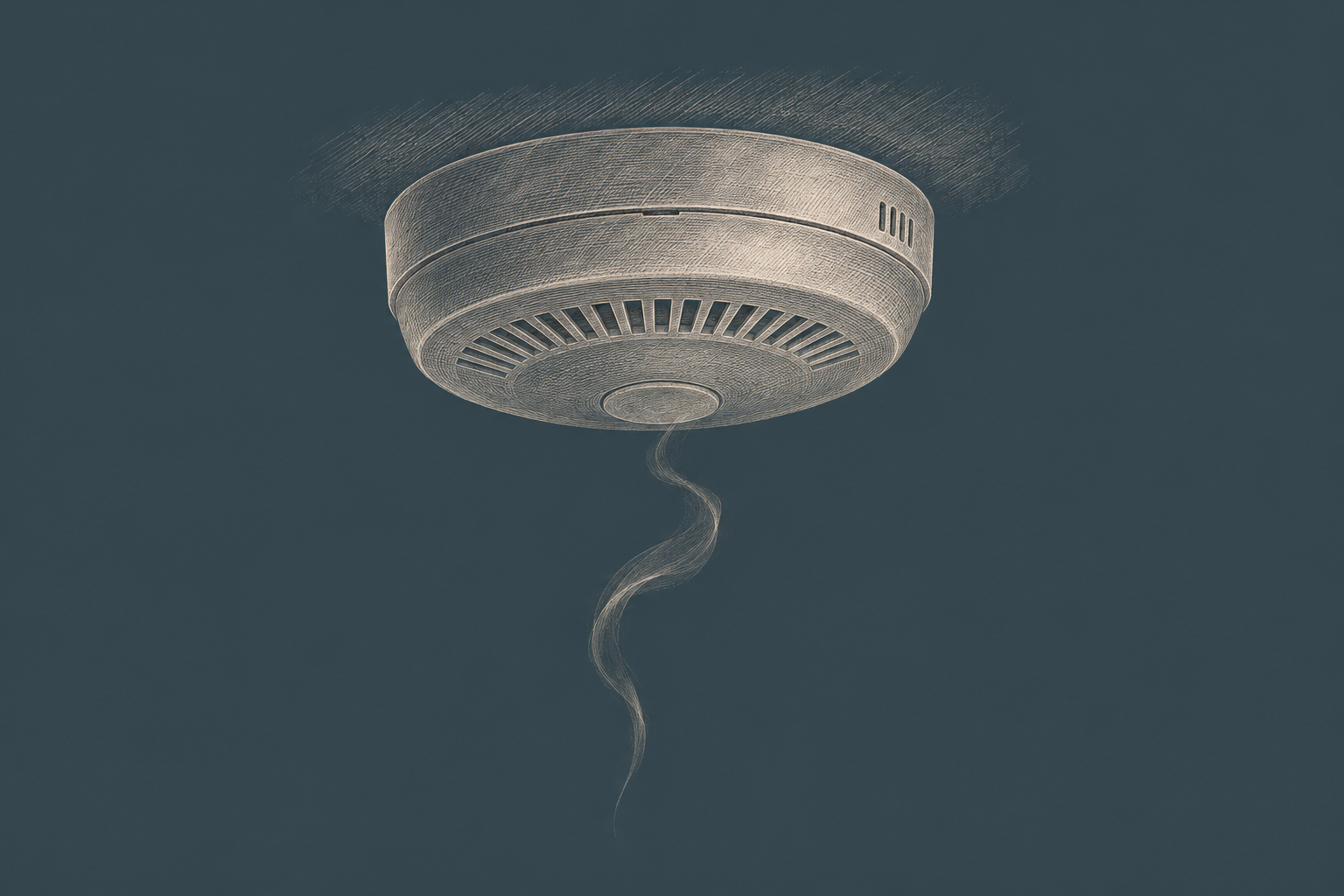
A sensitive scalp behaves like a smoke detector that triggers at the first hint of smoke.
That wall is the stratum corneum, the outermost layer of our skin. It is built like a brick wall, where dead skin cells form the bricks and lipids act as the mortar. As long as the mortar holds, water stays in the skin and foreign substances stay out. When it starts to crumble, those same substances can reach the nerve endings more easily. I find it entirely plausible, then, that a shampoo you have used for years without any trouble suddenly burns on a compromised skin barrier. So which ingredients are worth looking at?

The stratum corneum resembles a brick wall. Skin cells are the bricks, lipids the mortar. Where the mortar is missing, irritants get through more easily.
Which Ingredients Most Commonly Irritate the Scalp?
The usual repeat offenders when it comes to scalp irritation are fragrances, dyes, preservatives, denatured alcohol, emulsifiers, and (as harmless as they sound) certain plant extracts. Dermatologists list very similar groups when they review hair care products for allergens: preservatives, surfactants, emulsifiers, fragrances, and dyes (Karim et al., 2023).
The skin responds through two distinct pathways. An irritant reaction (the kind you typically feel within minutes) can affect anyone if the dose is high enough or the skin barrier is compromised. A contact allergy, on the other hand, requires an immune system that has already encountered the substance. It shows up with a delay. With the hair dye ingredient p-phenylenediamine, several hours to days can pass between dyeing and the first symptoms (Mukkanna et al., 2017). That delay is exactly what makes tracking down the cause so frustrating. Who thinks on Thursday about the hair mask they used on Tuesday?
Which substances come up most often in allergy testing is shown in the review referenced in the box above. It only captures people who presented to a dermatologist with scalp contact eczema and underwent patch testing, so it tells us nothing about how often a healthy scalp reacts to these same substances.
| Substance group | How it appears on the label | Frequency according to the review |
|---|---|---|
| Hair dye | p-Phenylenediamine | 23% |
| Fragrances | Parfum or Fragrance, plus individual names such as Linalool and Limonene | 13% (fragrance mix) |
| Surfactant | Cocamidopropyl Betaine | 7% (including accompanying substance) |
| Preservatives | Methylchloroisothiazolinone, Methylisothiazolinone | 6% |
Source: Pham et al., 2022. The same ranking also includes nickel at 15% (which you won't find on any ingredient list) and Peru balsam at 10%, a fragrant tree resin.
These allergies are not rare in the general population either. When researchers tested 3,119 randomly selected adults from five European countries, just under 2% reacted to one of the two common fragrance mixes, and 1% reacted to p-phenylenediamine (Diepgen et al., 2016). Scaled up, that means a handful of people in every full cinema have skin that reacts allergically to fragrances.
Denatured alcohol from my list does not appear in this ranking at all. On the label it goes by "Alcohol denat." What those two inconspicuous words actually mean, the packaging won't tell you.
What Does "Alcohol denat." Mean on the Label?
If your hair tonic or hair serum lists "Alcohol denat.", the bottle contains denatured alcohol. Denatured means the alcohol has been made undrinkable by adding certain substances. The reason for this extra step is straightforward: money. Denatured alcohol is exempt from alcohol tax, which keeps the purchase price down. And don't assume you'll only find it in budget products.
Germany's Alcohol Tax Ordinance lists four denaturing agents specifically for cosmetic products. These are the plasticiser diethyl phthalate, the thyme-derived compound thymol, a mixture of isopropanol and tertiary butanol, and the bittering agent denatonium benzoate combined with tertiary butanol. The main customs office can approve additional agents on a case-by-case basis (§ 54 AlkStV). Which of these denaturing agents is actually in your bottle is something you, as a consumer, have virtually no way of finding out. As a chemist, I consider this one of the most underestimated sources of irritation in scalp care. When a sensitive scalp reacts to a product containing denatured alcohol, the culprit is often not the alcohol itself but its additives. Some of these substances can act as allergens in their own right. And you're applying them directly to skin that's already reacting. The price difference for non-denatured alcohol, by comparison, is negligible.
What about the alcohol itself? As with so much in chemistry, it depends on where it ends up. It has been well studied on the skin of volunteers, prompted by research into hand disinfection in hospitals. In a series of experiments with 15 participants each, ethanol and two related alcohols at concentrations of 60 to 100% measurably dried out the skin, while the skin barrier itself remained intact and no redness occurred. In a wash test on the forearm, 80% alcohol actually caused less irritation than a surfactant (Löffler et al., 2007). On a robust scalp, I therefore consider alcohol a useful ingredient. It has a stimulating effect and helps active compounds reach their target more quickly.
On an irritated scalp, the picture looks different. The same series of experiments seems to contradict this at first glance, because the researchers also applied alcohol to skin they had previously irritated with a surfactant. Even there, it did not worsen the irritation (Löffler et al., 2007). What they measured were transepidermal water loss, redness, and skin moisture. Whether the alcohol burns is not captured by any of those three parameters. Burning, stinging, and itching are, however, exactly how you recognise a sensitive scalp.
How can alcohol burn without leaving measurable traces on the skin? It lowers the activation threshold of a heat and pain receptor in our nerve endings. This receptor is called TRPV1 and normally responds to temperatures above roughly 42 degrees Celsius. Under the influence of alcohol, it fires at around 34 degrees, which is below body temperature. This was measured in cells in a laboratory setting. The authors see this as the most likely explanation for why inflamed tissue responds so sensitively to alcohol (Trevisani et al., 2002). The same receptor is also suspected to play a role in sensitive skin more broadly (Misery et al., 2016).
There is another factor: alcohol draws moisture from the skin, and an irritated scalp can least afford to become drier. To my knowledge, no one has specifically measured this on irritated scalp skin. For me, that is reason enough to avoid alcohol there.
One more thing worth knowing: don't confuse the alcohol on the label with Cetyl Alcohol or Cetearyl Alcohol. Both carry the word alcohol in their name, but they are fatty alcohols, meaning waxy solids that have little in common with the liquid ethanol you'd find on your scalp. Ethanol appears on the label as "Alcohol" or, as discussed here, as "Alcohol denat."
What if the product isn't the problem at all?
Not every itchy scalp is reacting to an ingredient. A common condition that can be behind it is seborrhoeic eczema, with its yellowish, greasy flakes. It affects 1 to 3% of the population and tends to get worse in cold weather, dry air, and periods of stress (Clark et al., 2015). Involved is a yeast called Malassezia, which lives on every scalp and feeds on sebum. From the fats in that sebum, the yeast releases free fatty acids such as oleic acid, and some people respond to these with flaking and itching while others don't react at all (DeAngelis et al., 2005). This study came out of the labs at Procter & Gamble, a manufacturer of anti-dandruff shampoos. I don't find that objectionable, but you should know it. For this diagnosis, anti-dandruff shampoos and antifungal agents are the right tools. The pharmacy is the right place to start.
What makes this tricky is that a contact allergy of the scalp can look almost identical to seborrhoeic eczema and is therefore often mistaken for it (Hwang et al., 2024). With a hair dye allergy, the scalp itself often shows no visible inflammation at all, because the redness and blisters tend to appear at the hairline, around the ears, or on the face (Mukkanna et al., 2017).
In the following situations, I'd stop experimenting and book an appointment with a dermatologist.
- Your scalp is broken, weeping, or forming crusts.
- The flare-ups keep coming back, even after you've simplified your routine.
- The itching has lasted longer than six weeks. From that point on, doctors refer to it as chronic itch (Rupert and Honeycutt, 2022).
- You're seeing thick scaling patches or bare spots.
- The itching is all over your body without any visible rash. In that case, it's worth taking a look at liver function, kidney values, thyroid, and iron levels (Rupert and Honeycutt, 2022).
If your eyelids or face swell after colouring your hair, don't wait for an appointment. That's a case for urgent medical care.
How do you figure out what's irritating your scalp?
If those warning signs are absent, you can start investigating on your own. All it takes is patience and a pen.
- Read the back of every product that touches your scalp. That includes not just shampoo, but conditioner, hair masks, hairspray and hair dye. Mentally cross off anything your skin doesn't need.
- Start with the usual suspects. Fragrance, "Alcohol denat.", dyes and the two preservatives from the table are the first candidates. The shorter the ingredient list on your bottle, the fewer suspects remain.
- Change only one thing at a time. Don't switch products every week, or you'll never know what's actually helping your scalp. Since an allergic reaction can take hours or even days to show up, I'd give every change at least two weeks.
- Keep notes. Write down when the itching starts and what you used beforehand. After a few weeks, patterns emerge that you'd otherwise miss in the flow of daily life.
- Wash with lukewarm water and rinse thoroughly. For an irritated scalp, doctors recommend lukewarm water and mild, fragrance-free products (Rupert and Honeycutt, 2022). When the urge to scratch kicks in, cooling the scalp does more good than your fingernails.
- Bring your bottles to the dermatologist. A standard patch test can miss things. The products you actually use should be tested too (Hwang et al., 2024).

The fewer products and ingredients that touch your scalp, the faster you'll find the trigger.
I know that sounds like work. But nobody knows your scalp and your bathroom better than you do.
What can you actually put on an irritated scalp?
Cut enough out, and you're left with very little. That experience with Christine's scalp is exactly what led me to develop my hair serum CuraCap Sensitive. I formulated it without alcohol and without fragrance. It works with 6 ingredients: water, colloidal silver, biotin, and vitamins B3, B5, and B6.
Apply one to three pipettes directly to the scalp and leave the serum in without rinsing. Whether you use it daily or two to three times a week is something your scalp will tell you. A serum without alcohol is gentler on irritated areas, and massaging it in helps with nutrient absorption, as long as your scalp tolerates it.
A hair serum is, of course, not a medication. It neither treats eczema nor an allergy. Even with just six ingredients, a skin can react to one of them, but with six, you'll find the culprit quickly. That Christine's scalp responds well to it is our own experience and is not backed by any scientific study. How much of a topically applied vitamin actually reaches the hair root is, in any case, less well researched than nutrient supply through diet. I earn money from this serum, and you should know that. If you'd like to try it, you'll find it in the CuraCap shop. We currently ship to Switzerland and Liechtenstein, and to the EU on request.
Which ingredients most commonly irritate a sensitive scalp, and what you can do instead, I cover in detail in my book "Bis in die Haarspitzen gesund." It comes out on 9 February 2027. Head over to the book page to sign up, and you'll be the first to know where to get it.
Tonight, turn over the bottles in your bathroom and count how many ingredients your scalp is exposed to on an ordinary morning. Then start cutting, before you reach for yet another shampoo.
My hair serum for sensitive scalps. CuraCap Sensitive contains 6 ingredients and is free from alcohol and fragrance. You apply it directly to the scalp and leave it in. Order it at www.curacap.ch/en/shop/sensitive. The shop ships to Switzerland and Liechtenstein. If you're in the EU, add your name to the interest list. I'll be in touch, and we'll find a way.
FAQ
Why does my scalp itch even though I have no dandruff? Itching doesn't require visible dandruff. Sensitive skin is defined as a condition in which the skin can look completely normal (Misery et al., 2017). A contact allergy to hair dye often shows no visible signs on the scalp itself either. If the itching persists for more than six weeks, have it checked by a doctor.
Why does the scalp itch more in the evening and at night? That hasn't been conclusively resolved. What's being discussed is the daily rhythm of the signalling molecules that trigger itching, along with fluctuations in skin temperature and the skin barrier (Patel et al., 2007). In 16 healthy volunteers, the skin was more permeable in the evening and at night than in the morning (measured, however, on the forehead, forearm and shin, not on the scalp) (Yosipovitch et al., 1998). A cool bedroom makes the night more bearable (Rupert and Honeycutt, 2022).
Is alcohol in a hair serum bad for the scalp? That depends on your scalp. On a robust scalp, alcohol delivers active ingredients to where they need to go quickly. On an irritated scalp, I'd leave it out, as it dries out the skin and can sting. Also watch for the addition of "denat.", because behind it are denaturing agents that you as a customer have virtually no way of tracing.
Which shampoo helps with an itchy scalp? That depends on the cause. For yellowish, greasy dandruff, doctors typically recommend starting with an over-the-counter anti-dandruff shampoo and, for longer-term use, an antifungal shampoo (Clark et al., 2015). For a sensitive scalp without dandruff, I'd go with the mildest shampoo you can find, the shortest ingredient list, no fragrance.
Is it normal for the scalp to burn when colouring your hair? A burning sensation during the development time is a sign that the dye is irritating your scalp. I wouldn't dismiss that as harmless. Itching, redness or blisters that appear hours to days after colouring point to an allergic reaction (Mukkanna et al., 2017). If your eyelids or face swell, get medical help straight away.
Can stress trigger an itchy scalp? Stress can amplify what's already there. Seborrhoeic eczema typically flares during periods of stress (Clark et al., 2015). In a French survey, participants rated their emotional state as one of the most important triggers of a sensitive scalp (Misery et al., 2008).
References
- Misery L, Sibaud V, Ambronati M, Macy G, Boussetta S, Taieb C. Sensitive scalp: does this condition exist? An epidemiological study. Contact Dermatitis. 2008;58(4):234–8. PubMed 18353032
- Pham CT, Juhasz M, Lin J, Hashemi K, Honari G, Mesinkovska NA. Allergic Contact Dermatitis of the Scalp Associated With Scalp Applied Products: A Systematic Review of Topical Allergens. Dermatitis. 2022;33(4):235–248. PubMed 35318978
- Misery L, Ständer S, Szepietowski JC, Reich A, Wallengren J, Evers AW, et al. Definition of Sensitive Skin: An Expert Position Paper from the Special Interest Group on Sensitive Skin of the International Forum for the Study of Itch. Acta Derm Venereol. 2017;97(1):4–6. PubMed 26939643
- Misery L, Loser K, Ständer S. Sensitive skin. J Eur Acad Dermatol Venereol. 2016;30 Suppl 1:2–8. PubMed 26805416
- Karim M, Klein EJ, Nohria A, Taiwo D, Adotama P, Cohen D, et al. Potential for Allergic Contact Dermatitis in Popular Hair Care Practices and Ingredients. Dermatitis. 2023;34(6):484–491. PubMed 37339433
- Mukkanna KS, Stone NM, Ingram JR. Para-phenylenediamine allergy: current perspectives on diagnosis and management. J Asthma Allergy. 2017;10:9–15. PubMed 28176912
- Diepgen TL, Ofenloch RF, Bruze M, Bertuccio P, Cazzaniga S, Coenraads PJ, et al. Prevalence of contact allergy in the general population in different European regions. Br J Dermatol. 2016;174(2):319–29. PubMed 26370659
- § 54 AlkStV (gesetze-im-internet.de)
- Löffler H, Kampf G, Schmermund D, Maibach HI. How irritant is alcohol? Br J Dermatol. 2007;157(1):74–81. PubMed 17578437
- Trevisani M, Smart D, Gunthorpe MJ, Tognetto M, Barbieri M, Campi B, et al. Ethanol elicits and potentiates nociceptor responses via the vanilloid receptor-1. Nat Neurosci. 2002;5(6):546–51. PubMed 11992116
- Clark GW, Pope SM, Jaboori KA. Diagnosis and treatment of seborrheic dermatitis. Am Fam Physician. 2015;91(3):185–90. PubMed 25822272
- DeAngelis YM, Gemmer CM, Kaczvinsky JR, Kenneally DC, Schwartz JR, Dawson TL Jr. Three etiologic facets of dandruff and seborrheic dermatitis: Malassezia fungi, sebaceous lipids, and individual sensitivity. J Investig Dermatol Symp Proc. 2005;10(3):295–7. PubMed 16382685
- Hwang JC, Beatty CJ, Khobzei K, Kazlouskaya V. Allergic contact dermatitis of the scalp: a review of an underdiagnosed entity. Int J Womens Dermatol. 2024;10(3):e167. PubMed 39076889
- Rupert J, Honeycutt JD. Pruritus: Diagnosis and Management. Am Fam Physician. 2022;105(1):55–64. PubMed 35029946
- Patel T, Ishiuji Y, Yosipovitch G. Nocturnal itch: why do we itch at night? Acta Derm Venereol. 2007;87(4):295–8. PubMed 17598030
- Yosipovitch G, Xiong GL, Haus E, Sackett-Lundeen L, Ashkenazi I, Maibach HI. Time-dependent variations of the skin barrier function in humans: transepidermal water loss, stratum corneum hydration, skin surface pH, and skin temperature. J Invest Dermatol. 1998;110(1):20–3. PubMed 9424081
Dr Holger Scheib is a chemist and Honorary Associate Professor at the University of Queensland. As “The HealthChemist” he translates research on ingredients and nutrition into plain language. More about me
Shall I send you the next article?
I write irregularly but thoroughly: new articles, honestly sorted into proven, plausible and hypothesis. No spam, no sales funnel.
Last updated: 16 November 2026